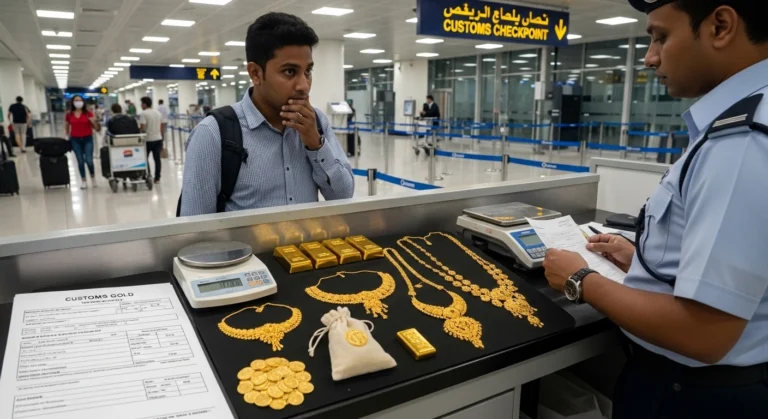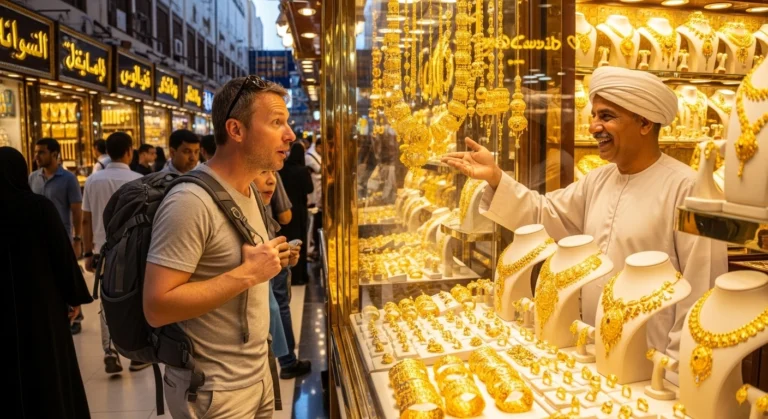
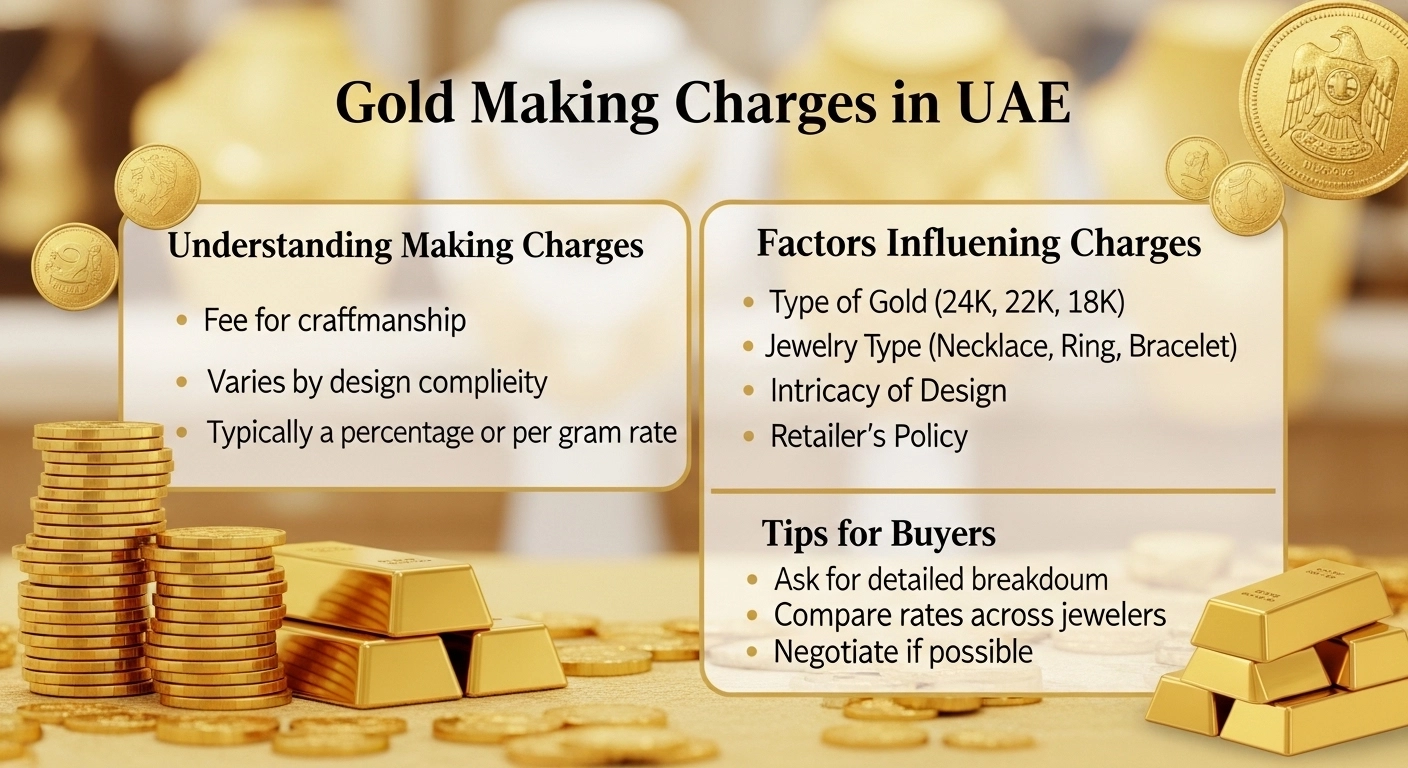
Gold Making Charges in UAE Explained
Many buyers in the UAE check the gold rate but still feel confused when the final jewelry price becomes higher than expected. This happens because of gold making charges in UAE explained, which are additional costs jewelers apply for designing and crafting the jewelry. Understanding these charges helps buyers calculate the real cost of a gold item and avoid overpaying when purchasing ornaments in Dubai or other Emirates.
In this guide, I will clearly explain what making charges are, why jewelers apply them, and how they influence the final price you pay. I will also show a simple calculation example so you can easily estimate jewelry cost using the live gold rate available on Gold Rate in UAE.
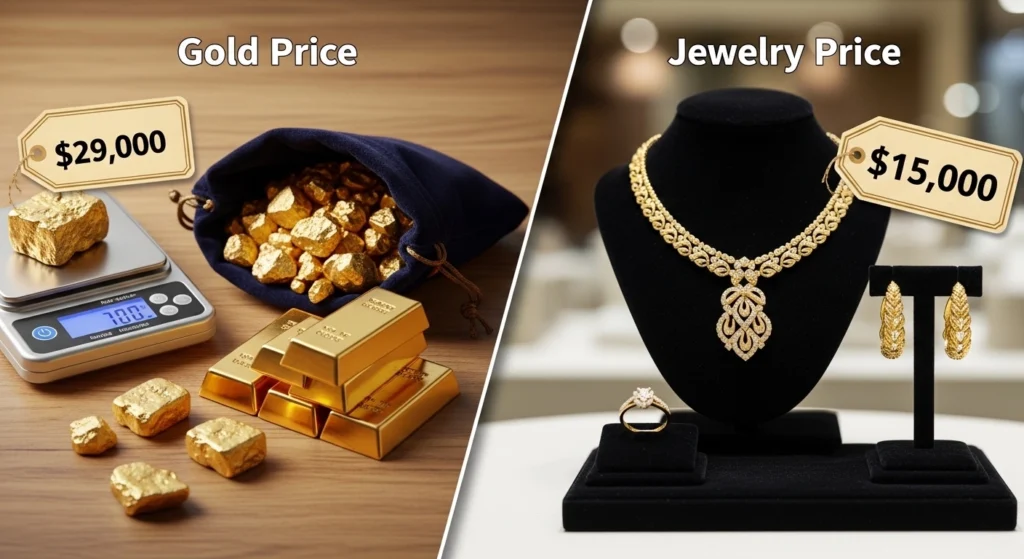
Difference Between Gold Price and Jewelry Price
Many first time buyers assume jewelry price is equal to the gold rate multiplied by weight. In reality, the final price includes multiple components.
The gold price is only the base metal value, which changes daily according to international market rates. If you want to see how gold prices move over time, you can check the gold price trends on Gold Price History Chart.
Jewelry price, on the other hand, includes:
| Component | Description |
|---|---|
| Gold Value | Weight of gold multiplied by live market price |
| Making Charges | Labor cost for designing and crafting jewelry |
| VAT | 5% UAE government tax |
| Final Price | Total price the customer pays |
This difference explains why two jewelry pieces with the same gold weight can still have different prices.
Why Making Charges Exist
Gold jewelry requires skilled craftsmanship, which is why jewelers apply making charges. These costs reflect the effort and expertise needed to produce high quality ornaments.
Several factors influence making charges in the UAE.
• Jewelry design complexity
• Handmade vs machine made production
• Brand reputation
• Stone or diamond settings
• Finishing and polishing work
Simple bangles or chains usually have lower making charges, while detailed bridal jewelry often has higher charges due to intricate craftsmanship.
Seasonal demand can also affect jewelry prices. During festivals and events such as promotions explained in Dubai Shopping Festival Gold Deals, some jewelers offer discounts or even zero making charges to attract buyers.
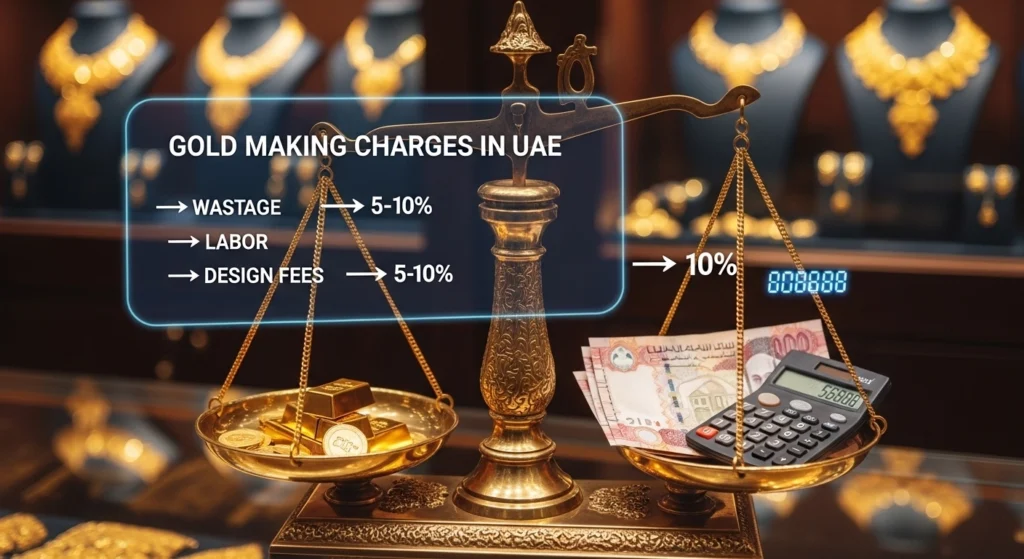
Typical Gold Making Charges in UAE
Gold making charges in the UAE usually range between 5 percent and 20 percent of the gold value depending on the jewelry type.
Here is a typical range buyers may encounter in 2026.
| Jewelry Type | Typical Making Charges |
|---|---|
| Simple Chains | 5% – 8% |
| Rings | 8% – 12% |
| Bracelets | 10% – 15% |
| Bridal Jewelry | 15% – 20% |
Large jewelry retailers may charge slightly higher fees because of brand value, showroom costs, and design exclusivity.
Understanding these ranges helps buyers compare prices across cities such as Dubai, Abu Dhabi, or Sharjah using the local price pages like Gold Rate in Abu Dhabi and Gold Rate in Sharjah.
Example Calculation of Gold Jewelry Price
To clearly understand how making charges affect the final price, consider this example.
| Component | Example Cost |
|---|---|
| Gold Price (10g) | 2400 AED |
| Making Charges | 300 AED |
| VAT (5%) | 135 AED |
| Final Price | 2835 AED |
In this case, the buyer pays 435 AED more than the gold value because of making charges and VAT.
If you want to estimate jewelry cost instantly before visiting a shop, you can also use the gold calculator available on Gold Price Calculator.
Why Buyers Should Understand Making Charges
Understanding gold making charges is important because it allows buyers to compare jewelry prices properly instead of focusing only on gold rate.
Many experienced buyers negotiate making charges or choose simpler designs to reduce overall cost. This is one of the reasons Dubai remains attractive for international buyers, especially Indians, as explained in Why Indians Buy Gold from Dubai.
When buyers understand these charges, they can make smarter purchasing decisions and get better value for their money.
What Are Gold Making Charges?
Many first time gold buyers focus only on the daily gold rate and later feel surprised when the jewelry price becomes higher at the billing counter. This confusion usually happens because of gold making charges, which are the additional costs jewelers charge for crafting raw gold into finished ornaments. Understanding what gold making charges are helps buyers calculate the real jewelry cost and avoid paying more than expected when purchasing gold in the UAE.
In this section, I will explain what making charges include, how jewelers calculate them, and why they vary from one design to another. Once you understand these factors, it becomes easier to estimate the final jewelry price using the live gold rate in UAE available.
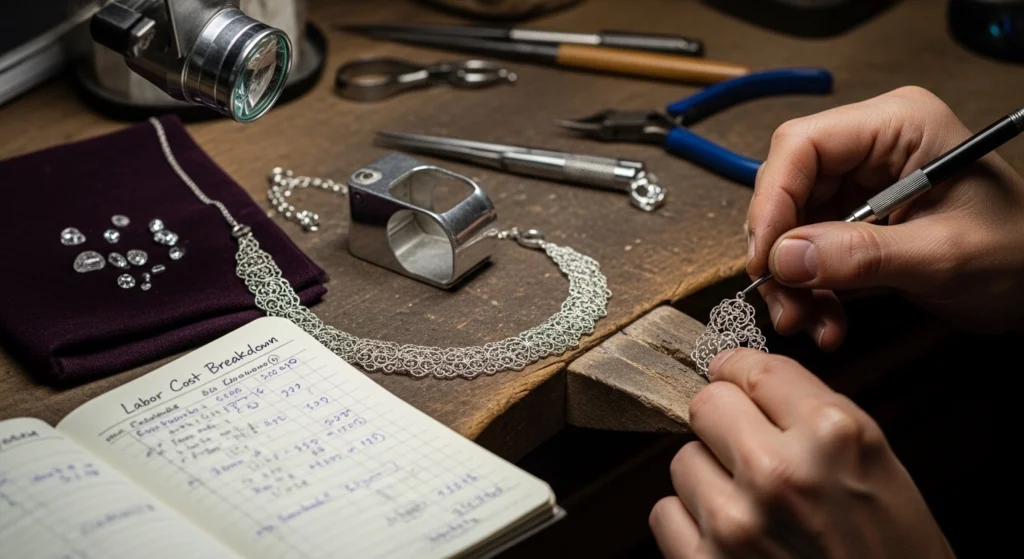
Labor Cost for Crafting Jewelry
Gold jewelry is not simply melted and shaped. Skilled artisans spend hours designing, shaping, engraving, and polishing each piece. The cost of this craftsmanship is included in the making charges.
For example, a simple gold ring may require basic machine work and polishing, while a bridal necklace may take several hours of detailed handcrafting. The more effort required to produce the jewelry, the higher the making charges become.
Design Complexity and Its Impact on Cost
The design of the jewelry plays a major role in determining making charges. Simple and minimal designs usually have lower labor requirements, while detailed designs require additional time and expertise.
Intricate jewelry such as traditional bridal sets, engraved bangles, or gemstone embedded pieces often have higher making charges because artisans must carefully craft each small detail. This is one reason why decorative wedding jewelry in the UAE can cost significantly more than plain gold ornaments.
Seasonal demand can also influence pricing. For example, jewelry demand often increases during events discussed in Wedding Season Gold Demand in UAE, which can affect overall jewelry pricing and craftsmanship demand.
24k gold price in dubai per gram today in usd
Many people searching for 24k gold price in dubai per gram today in usd are trying to solve a simple but important problem. They want to know the exact gold…1 gram gold price in Dubai in Indian rupees today live
Many people searching for 1 gram gold price in dubai in indian rupees today live are trying to solve a very practical problem. They want to know the exact price…
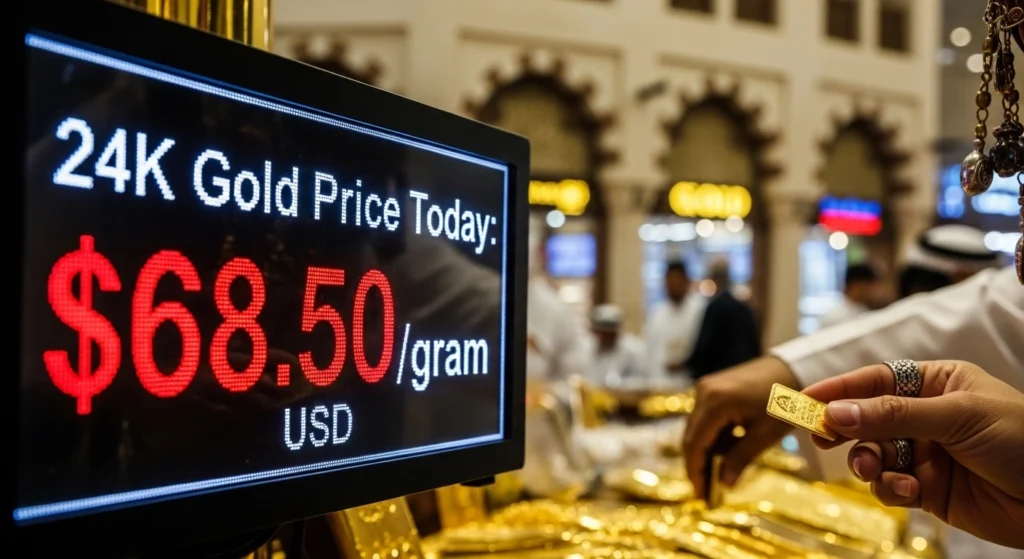


Machine Made vs Handmade Jewelry
Jewelry manufacturing in the UAE usually follows two methods. Machine production and handmade craftsmanship.
Machine made jewelry is produced using automated tools, which reduces labor time and keeps making charges relatively lower. These pieces are usually lightweight and simple in design.
Handmade jewelry requires skilled artisans who manually shape and assemble the piece. Because this process takes longer and involves craftsmanship expertise, handmade jewelry typically has higher making charges.
How Jewelers Calculate Making Charges
Jewelers in the UAE generally calculate making charges in two ways. Some charge a fixed cost per gram, while others apply a percentage of the gold value.
For example, if the gold price for 10 grams is based on the current market rate and the jeweler charges 10 percent making fees, that percentage is added to the base gold value before VAT is applied. Buyers who want to estimate these costs beforehand can use the gold calculator on Gold Price Calculator to understand the approximate final price.
Understanding this calculation also helps buyers compare jewelry prices with international gold rates discussed in Dubai Gold Rate vs International Gold Price.
Common Factors Included in Making Charges
Several elements contribute to gold making charges in UAE jewelry stores.
Common factors included in making charges:
• Design complexity
• Labor time required to craft the jewelry
• Manufacturing process such as machine made or handmade
• Finishing work including polishing, engraving, and detailing
Because these factors vary from one piece to another, making charges are rarely the same across different jewelry items.
How Gold Making Charges Are Calculated in UAE
Many buyers in the UAE understand that making charges exist, but the real confusion comes when trying to figure out how gold making charges are calculated in UAE jewelry stores. Different jewelers use different pricing models, which can significantly affect the final price of the jewelry. If buyers do not understand these calculation methods, they may find it difficult to compare prices between stores or estimate the real cost of a gold item.
In this section, I will explain the main methods jewelers use to calculate making charges in the UAE. Once you understand these pricing models, it becomes easier to evaluate jewelry prices and identify fair deals when buying gold.
Percentage of Gold Value
One of the most common methods used by jewelers is calculating making charges as a percentage of the gold value. In this method, the jeweler applies a certain percentage to the total gold price based on the weight and purity of the jewelry.
For example, if a jewelry piece contains gold worth 3000 AED and the jeweler charges a 10 percent making fee, the making charge would be 300 AED. This method is commonly used for premium jewelry because the labor cost often increases with design complexity and craftsmanship.
Percentage based pricing is frequently applied to intricate jewelry designs, bridal sets, and pieces that involve additional artistic detailing.
Fixed Charge Per Gram
Another popular pricing method is the per gram making charge, where jewelers apply a fixed cost for every gram of gold used in the jewelry piece.
For instance, if the jeweler charges 30 AED per gram and the jewelry weighs 15 grams, the making charge becomes 450 AED. This method is widely used for standard jewelry items such as simple chains, bangles, and rings because it provides a predictable pricing structure.
Many buyers prefer this model because it is easier to calculate and compare across different stores.
Flat Price for Jewelry Pieces
Some jewelers use a flat making charge for the entire jewelry piece, especially when the item has a fixed design or belongs to a designer collection.
In this model, the jeweler may charge a fixed amount such as 500 AED regardless of the exact gold weight. This pricing approach is often used for designer jewelry pieces where the design value and craftsmanship are considered more important than the weight of the gold itself.
Flat pricing is commonly seen in branded jewelry collections or limited edition designs.
Combination Pricing Model
In many cases, jewelers combine multiple pricing methods to calculate the final making charge. For example, a jeweler may apply a per gram making charge and also add a fixed design fee for intricate craftsmanship.
This hybrid model allows jewelers to cover both the material handling cost and the artistic work involved in producing the jewelry. It is especially common in high end jewelry stores where design complexity varies significantly from piece to piece.
Understanding these calculation models also helps buyers evaluate whether the jewelry price aligns with the broader gold market factors explained in What Effects Gold price in UAE.
Comparison of Gold Making Charge Methods in UAE
The following table summarizes the most common methods used by jewelers in the UAE.
| Method | Example | When Used |
|---|---|---|
| Percentage | 10% of gold price | Premium jewelry |
| Per gram | 20–50 AED per gram | Standard jewelry |
| Fixed price | 500 AED per piece | Designer items |
Each method has its own advantages depending on the jewelry type and design complexity. Buyers who understand these models can compare jewelry prices more effectively and choose options that offer better value.
Average Gold Making Charges in UAE Jewelry Shops
Many gold buyers assume that jewelry prices are almost the same across the UAE, but the reality is different. Average gold making charges in UAE jewelry shops vary widely depending on the store type, design complexity, and location of the shop. Buyers who do not understand these differences may end up paying significantly higher craftsmanship fees for similar jewelry.
In this section, I will explain the realistic making charge ranges buyers encounter in the UAE market, including the differences between budget shops, luxury jewelry brands, and traditional gold markets like Dubai Gold Souk. Understanding these ranges helps buyers estimate jewelry costs more accurately before purchasing.
Typical Making Charge Percentages in UAE
In most UAE jewelry stores, making charges typically range between 5 percent and 25 percent of the gold value, depending on the design and craftsmanship involved. Simple jewelry pieces such as plain chains or basic bangles usually fall at the lower end of the range, while intricate or designer jewelry can reach much higher percentages.
For example, simple designs may carry around 3 to 8 percent making charges, while medium complexity designs often range between 8 and 15 percent. Highly intricate or custom jewelry pieces can exceed 20 percent due to the additional craftsmanship required.
These percentages are widely used in the UAE jewelry market, although some stores also convert them into per gram charges depending on their pricing structure.
Differences Between Budget and Luxury Jewelry Stores
Making charges can vary significantly depending on the type of jewelry retailer. Budget jewelry shops usually focus on high volume sales and therefore maintain lower craftsmanship fees.
Traditional shops or mid range retailers often charge around 6 percent to 12 percent making charges for standard 22K jewelry pieces. On the other hand, luxury boutiques and designer jewelry stores may charge 15 percent to 25 percent or even higher because of exclusive designs and brand reputation.
Luxury stores also include additional services such as custom design work, premium finishing, and branded packaging, which further increases making charges.
Dubai Gold Souk vs Mall Jewelry Stores
Where you buy gold in the UAE also affects the making charges you pay. Traditional markets such as the Dubai Gold Souk often offer lower making charges because shops operate with smaller margins and higher sales volumes.
Typical making charges in traditional gold markets can range from 4 percent to 10 percent, and buyers can sometimes negotiate these charges depending on the purchase size. In contrast, mall based jewelry stores usually charge higher fees because of showroom rent, branding costs, and fixed pricing policies.
This is one of the reasons experienced buyers often compare multiple shops before purchasing gold jewelry.
For buyers who want to understand the relationship between jewelry pricing and global markets, it is also helpful to review how international gold price movements affect UAE jewelry pricing in Does USD affect Gold price in UAE.
Average Making Charges by Jewelry Type
Different jewelry categories also have different making charge ranges depending on craftsmanship complexity.
| Jewelry Type | Avg Making Charges |
|---|---|
| Simple chain | 5% – 8% |
| Bangles | 8% – 12% |
| Bridal sets | 12% – 20% |
| Designer jewelry | 20% – 35% |
These ranges reflect typical market pricing patterns observed in the UAE jewelry industry.
Simple chains and basic jewelry pieces remain the most affordable options because they require less labor and simpler manufacturing techniques. On the other hand, bridal jewelry and designer pieces involve detailed craftsmanship, gemstone settings, and custom design work, which significantly increases the making charges.
In general, understanding these averages helps buyers identify whether a jewelry quote is reasonable or overpriced before making a purchase.
Factors That Influence Gold Making Charges
Many buyers notice that two jewelry pieces with the same gold weight can still have very different prices. This happens because several factors influence gold making charges, and jewelers adjust their craftsmanship fees depending on design, production method, and additional work involved. If buyers understand these factors, they can easily identify why certain jewelry pieces cost more and choose options that match their budget.
In this section, I will explain the main factors that increase or reduce making charges in the UAE jewelry market. These insights help buyers compare jewelry prices more accurately and understand how the final price is calculated, which is also explained in detail in How Gold Price is Calculated in UAE.
Jewelry Design Complexity
Jewelry design is one of the biggest factors affecting making charges. Simple designs require less time and fewer steps to produce, which keeps the craftsmanship cost lower.
Intricate designs with detailed patterns, filigree work, or artistic engravings require skilled artisans and additional production time. Because of this extra effort, complex jewelry designs usually carry significantly higher making charges compared to plain jewelry pieces.
Bridal necklaces, detailed bangles, and ornamental rings are common examples where design complexity increases craftsmanship fees.
Handmade vs Machine Made Jewelry
The manufacturing process also plays a major role in determining making charges. Jewelry produced using machines usually requires less labor time, which reduces overall crafting costs.
Handmade jewelry, however, involves artisans manually shaping, assembling, and finishing each piece. This process requires expertise and careful attention to detail, which naturally increases labor costs. As a result, handmade jewelry often has higher making charges than machine produced pieces.
In many UAE jewelry stores, handcrafted items are marketed as premium products because they offer unique design quality and craftsmanship.
Brand Premium
Brand reputation can also influence making charges. Well known luxury jewelry brands often charge higher craftsmanship fees compared to local jewelry shops.
This premium usually covers design exclusivity, branding value, and showroom experience. Luxury retailers also invest in marketing, design development, and premium packaging, which adds to the final price of the jewelry.
Buyers often pay this additional cost for brand assurance, design uniqueness, and perceived quality.
Gold Purity
Gold purity can affect the jewelry manufacturing process. In the UAE market, most jewelry is made using 22K gold, which provides the right balance between durability and purity.
Higher purity gold such as 24K is softer and more difficult to craft into complex jewelry designs. Because of these technical challenges, jewelers sometimes apply different production methods when working with higher purity gold.
This can slightly influence making charges depending on the jewelry type and design requirements.
Stone or Diamond Setting
Jewelry pieces that include gemstones, diamonds, or decorative stones usually have higher making charges. Setting stones into gold requires additional precision work and specialized tools.
Each gemstone must be carefully placed, secured, and polished, which increases the labor time involved in producing the jewelry. This additional craftsmanship is reflected in the making charges applied by the jeweler.
Designer rings, bridal sets, and luxury necklaces often include gemstone settings, which is why they typically carry higher labor costs.
Summary of Factors Affecting Making Charges
The following table summarizes how different factors impact gold making charges.
| Factor | Impact on Charges |
|---|---|
| Complex design | Higher |
| Handmade | Higher |
| Machine made | Lower |
| Brand name | Higher |
Understanding these factors helps buyers make smarter purchasing decisions and compare jewelry prices more effectively across different stores. Buyers who analyze design complexity, craftsmanship type, and brand premiums can often find jewelry options that provide better value without paying unnecessarily high making charges.
Making Charges in Dubai vs Other UAE Emirates
Many gold buyers assume that making charges are the same across the UAE, but in reality they can vary depending on the city and the type of jewelry market. Making charges in Dubai vs other UAE Emirates differ mainly due to competition, market demand, and operating costs of jewelry stores. Buyers who compare prices across different Emirates often find noticeable differences in craftsmanship fees.
In this section, I will explain how making charges vary between Dubai, Abu Dhabi, Sharjah, and Ajman. Understanding these regional differences helps buyers choose the best location for purchasing gold jewelry while keeping craftsmanship costs under control.
Dubai Gold Souk Competition
Dubai is widely known as one of the largest gold trading hubs in the world. Areas such as the traditional Gold Souk have hundreds of jewelry retailers competing for customers. Because of this intense competition, many shops keep their making charges relatively competitive, especially for standard jewelry items.
Buyers often find lower or negotiable making charges in traditional markets compared to luxury malls. This competitive environment is one reason Dubai attracts international gold buyers and tourists. Those planning to purchase jewelry as visitors can learn more practical tips in How to Buy Gold in Dubai as a Tourist.
Abu Dhabi Jewelry Markets
Abu Dhabi also has a strong jewelry retail market, but the number of shops is smaller compared to Dubai. Many jewelry stores in Abu Dhabi operate in high end malls and branded showrooms.
Because of higher operational costs and luxury retail environments, making charges in Abu Dhabi are often slightly higher than those in Dubai’s traditional gold markets. Buyers can compare current local prices through Gold Rate in Abu Dhabi to understand the broader market pricing in the capital.
Sharjah and Ajman Price Differences
Sharjah and Ajman usually offer slightly lower jewelry prices compared to larger cities. Jewelry stores in these Emirates often serve local residents rather than tourists, which means pricing strategies tend to focus on affordability and regular customers.
Because operating costs such as shop rent are generally lower than in Dubai malls, jewelers in Sharjah and Ajman may offer more competitive making charges, especially for simple gold jewelry.
Buyers can explore local market rates through Gold Rate in Ajman when comparing prices across Emirates.
Tourist Markets vs Local Markets
Tourist heavy markets sometimes have slightly higher jewelry prices due to premium store locations and international customer demand. However, competitive markets like Dubai Gold Souk still maintain reasonable making charges because of the large number of retailers.
Local neighborhood jewelry shops in smaller Emirates often rely on repeat customers, which encourages more transparent pricing and lower labor charges. Experienced buyers usually visit multiple shops to compare offers before making a purchase.
Typical Making Charges Across UAE Emirates
The following table shows the common making charge ranges across major UAE Emirates.
| Emirate | Typical Making Charges |
|---|---|
| Dubai | 5% – 20% |
| Abu Dhabi | 7% – 22% |
| Sharjah | 5% – 18% |
| Ajman | 5% – 17% |
These ranges represent common pricing patterns observed across jewelry markets in the UAE. Actual charges may vary depending on jewelry design, craftsmanship requirements, and the reputation of the jewelry store.
Understanding these regional differences allows buyers to make more informed decisions and potentially save money when purchasing gold jewelry in the UAE.
Gold Making Charges During Festival Offers
Many gold buyers in the UAE wait for seasonal promotions because gold making charges during festival offers are often significantly reduced or completely waived. Jewelry retailers regularly introduce promotional campaigns during major shopping events to attract customers and increase sales. Buyers who purchase during these periods can save a noticeable amount because making charges are one of the largest additional costs in gold jewelry pricing.
In this section, I will explain how seasonal events such as Dubai Shopping Festival, Ramadan, Eid, and wedding season promotions influence making charges. Understanding these promotional periods helps buyers plan purchases strategically and reduce the overall cost of gold jewelry.
Dubai Shopping Festival Offers
The Dubai Shopping Festival is one of the biggest retail events in the UAE and it often includes attractive gold jewelry promotions. During this festival, many jewelry retailers compete by offering zero making charges or heavily discounted labor costs on selected jewelry items.
These promotions are designed to increase foot traffic in gold markets and shopping malls. Buyers often find deals such as free making charges on selected pieces or limited time discounts on craftsmanship fees. More details about these seasonal promotions can be explored in Dubai Shopping festival gold deals.
Ramadan Promotions
Ramadan is another important period when jewelry retailers launch special promotions. Many stores reduce making charges or provide discounts on labor costs during this month to encourage festive shopping.
Some retailers also introduce bundle deals where buyers receive reduced making charges when purchasing multiple jewelry items. Gold demand usually increases during Ramadan because families often buy jewelry for gifts and celebrations. Buyers can understand seasonal price trends in Gold Price During Ramadan in UAE.
Eid Discounts
Eid celebrations also bring promotional offers in jewelry markets across the UAE. During this time, jewelers introduce special Eid discounts, which may include reduced making charges, gift vouchers, or promotional pricing on selected collections.
Many families purchase jewelry as gifts during Eid, so retailers use these promotions to attract buyers looking for festive purchases.
Wedding Season Deals
The wedding season is another major driver of gold demand in the UAE. Bridal jewelry sets often involve high making charges due to their complex designs, but retailers sometimes offer special wedding season deals to attract buyers.
These offers may include discounted craftsmanship fees, package pricing for bridal jewelry sets, or promotional labor costs for bulk purchases. Buyers planning wedding jewelry purchases can learn more about demand patterns in Wedding Season Gold Demand in UAE .
Typical Festival Promotions on Making Charges
Seasonal promotions often reduce or remove making charges for limited periods. The table below highlights common promotional offers buyers may encounter.
| Event | Typical Offer |
|---|---|
| Dubai Shopping Festival | 0% making charges deals |
| Ramadan | Discounted labor cost |
| Eid | Special promotional offers |
These promotions can help buyers save a significant amount because making charges may account for 5 percent to 20 percent of the jewelry price. Planning purchases during these events is one of the easiest ways to reduce the total cost of gold jewelry in the UAE.
UAE Gold Making Charges vs Other Countries
Many international buyers notice that gold making charges in the UAE are often lower compared to other countries, which is one reason Dubai and other Emirates remain popular for gold purchases. Buyers often assume that jewelry prices in their home countries are comparable, but factors like competition, taxes, and production scale make UAE gold more cost effective in terms of craftsmanship fees. Understanding these differences helps buyers plan purchases and avoid overpaying abroad.
In this section, I will explain why UAE making charges are relatively lower and compare them with typical charges in countries like India, the UK, and Singapore. This information is especially useful for tourists and international shoppers looking for value for money.
High Competition in Dubai Gold Markets
Dubai hosts one of the largest gold trading hubs globally, with hundreds of jewelry shops concentrated in areas such as the Gold Souk. The high level of competition among retailers keeps making charges lower and often negotiable. Retailers aim to attract both local and international customers, which encourages more transparent and competitive pricing.
This competitive environment contrasts with smaller or less saturated jewelry markets in other countries, where fewer retailers lead to higher making charges.
Lower Import Taxes
The UAE has relatively low import duties on gold, which reduces the overall cost structure for jewelry retailers. Because the base cost of raw gold is lower due to minimal import taxes, jewelers can pass on savings to customers through reduced making charges.
In countries like India, import duties, customs, and GST increase the base cost, often making both the gold price and labor charges higher.
Large Scale Manufacturing
Many jewelry workshops in the UAE operate on a large scale with modern equipment and skilled labor. Mass production of standard jewelry designs allows retailers to reduce labor costs per piece, which in turn keeps making charges lower.
Handmade or boutique jewelry may still carry higher charges, but overall, the scale of production in UAE markets contributes to lower average craftsmanship fees compared to smaller markets abroad.
Tourism Driven Pricing Strategies
UAE jewelry retailers cater heavily to international tourists who often compare prices with their home countries. To remain competitive and attractive to buyers, shops sometimes reduce making charges or offer promotions. Seasonal events such as the Dubai Shopping Festival further encourage jewelry stores to maintain competitive craftsmanship fees.
This tourism driven approach is less common in countries where most buyers are local residents, resulting in higher making charges.
Comparison of Average Making Charges by Country
The table below highlights typical making charge ranges in UAE and other popular gold markets:
| Country | Typical Making Charges |
|---|---|
| UAE | 5% – 20% |
| India | 8% – 25% |
| UK | 10% – 30% |
| Singapore | 8% – 22% |
As shown, UAE making charges are generally lower, making it an attractive destination for buyers seeking jewelry with better craftsmanship value. For buyers comparing prices internationally, understanding these differences helps in planning purchases strategically.
How to Reduce Gold Making Charges When Buying Jewelry
Many buyers in the UAE focus only on the gold rate and overlook the fact that making charges can significantly increase the final jewelry price. Without strategies to reduce these charges, even a moderately priced gold piece can become expensive. Understanding how to minimize making charges helps buyers save money without compromising on quality or design.
In this section, I will share practical strategies to lower making charges when purchasing gold jewelry in the UAE. These tips are easy to implement and help buyers make smarter, cost effective decisions.
Practical Ways to Reduce Making Charges
- Compare Multiple Jewelry Shops
Visiting different shops allows buyers to compare making charges for the same jewelry type. Traditional markets like Dubai Gold Souk often offer lower fees than mall based retailers. Comparing prices ensures you pay a fair amount for craftsmanship. - Buy During Gold Festival Offers
Seasonal promotions such as the Dubai Shopping Festival, Ramadan, and Eid often include reduced or zero making charges on selected jewelry items. Planning purchases during these events can save a substantial amount. For more details, see Dubai Shopping Festival Gold Deals. - Choose Simple Jewelry Designs
Complex and intricate designs require more labor, which increases making charges. Opting for simpler patterns or plain chains can reduce craftsmanship fees while still providing beautiful jewelry. Simple designs also allow easier resale if needed in the future. - Negotiate Making Charges
Many jewelry retailers in traditional markets are open to negotiation. Discussing and requesting a lower making charge can result in significant savings, especially for high value purchases. Negotiating is easier when you are aware of typical charge ranges in the UAE. - Avoid Luxury Brand Markups
Luxury and branded jewelry stores often charge higher making fees to cover brand reputation and packaging. Choosing reputable local stores or mid tier shops can help buyers get quality jewelry at lower making charges. Checking rates at Gold Rate in Dubai can help identify competitive pricing.
Implementing these strategies ensures buyers can purchase gold jewelry in the UAE while minimizing unnecessary additional costs, allowing more value from every purchase.
How Making Charges Affect Gold Resale Value
Many buyers assume that the full price paid for gold jewelry, including making charges, will be recovered when selling it. This is a common misunderstanding, as making charges do not add value to the resale price. Understanding how making charges impact resale is crucial for buyers and investors who want to make informed decisions about jewelry purchases in the UAE.
In this section, I will explain why making charges are non refundable during resale, how gold resale value is determined, and why investors often prefer gold bars or coins over jewelry for long term wealth preservation.
Making Charges Are Not Refunded on Resale
When selling gold jewelry, jewelers and resale markets only consider the weight and purity of the gold. The labor and craftsmanship costs included in making charges are not recovered because they are treated as service fees for producing the jewelry.
This means that a buyer who paid high making charges for a designer necklace or bridal set will not recoup those costs when selling the jewelry, even if the gold itself has appreciated in price.
Gold Resale Value Depends Only on Weight and Purity
Resale prices are calculated based on the current gold market rate and the actual weight of the gold in the jewelry. Factors such as design complexity, brand, or making charges do not influence resale value.
For instance, 10 grams of 22K gold purchased with high making charges will always be valued on resale based on 10 grams of 22K gold only, not the final purchase price. This is why buyers looking for investment returns often focus on the metal itself rather than decorative jewelry.
Why Investors Prefer Gold Bars or Coins
Investors who prioritize resale value and liquidity usually prefer gold bars or coins. These items do not include making charges and are priced solely on the gold content. As a result, investors can sell them quickly at market rates without losing a portion of the purchase price to labor costs.
This approach is especially popular in Dubai and other UAE Emirates, where international buyers seek gold for both gifting and investment purposes. For more insights on UAE vs India gold prices, buyers can check How much Cheaper is Dubai Gold for Indians.
Example of How Making Charges Affect Resale
| Purchase Price | Resale Value |
|---|---|
| Gold + Making Charges | Paid by buyer |
| Gold Weight Only | Paid during resale |
As shown in the table, making charges are paid upfront but do not contribute to resale value, emphasizing the importance of understanding these costs before purchasing decorative jewelry. Buyers planning for resale should consider limiting making charges or choosing simpler designs to minimize potential loss.
Mistakes Buyers Make When Paying Making Charges
Many gold buyers in the UAE focus solely on the daily gold rate and overlook the impact of making charges on the final price. This often leads to overpaying, especially for jewelry purchased during high demand periods or in branded stores. Understanding common mistakes helps buyers make smarter decisions and avoid unnecessary costs.
In this section, I will highlight frequent errors buyers make when paying making charges and provide tips to prevent them. Awareness of these pitfalls can save significant amounts, particularly when buying high value jewelry.
Common Mistakes Buyers Make
- Not Asking the Making Charge Percentage
Some buyers assume the making charge is fixed or the same for all jewelry. Failing to ask the jeweler about the exact percentage or per gram charge can result in overpaying, especially for intricate designs. - Ignoring Discounts and Seasonal Offers
Festival periods such as Dubai Shopping Festival, Ramadan, or Eid often include reduced or zero making charges. Buyers who ignore these promotions miss opportunities to save on craftsmanship fees. Learn more about seasonal deals in Dubai Shopping Festival Gold Deals. - Buying During Peak Demand
Jewelry prices, including making charges, can increase during high demand seasons such as wedding months or festive periods. Buying during peak demand without checking multiple options can lead to paying more than necessary. - Not Comparing Shops
Making charges vary significantly between stores, even for similar jewelry pieces. Failing to compare multiple shops especially across traditional markets like Dubai Gold Souk and mall retailers can result in higher costs. Buyers can check local rates on pages like Gold Rate in Abu Dhabi or Gold Rate in Sharjah for guidance. - Confusing Making Charges with Gold Price
Some buyers assume the final jewelry price reflects only the gold value. Misunderstanding that making charges are a separate component often leads to paying more than intended and surprises at checkout.
Being aware of these common mistakes ensures that buyers can plan purchases strategically, take advantage of offers, and minimize unnecessary expenditure on gold making charges.
Tools to Calculate Gold Jewelry Price in UAE
Many buyers in the UAE feel uncertain about the final cost of gold jewelry because making charges, VAT, and daily gold rate fluctuations all affect the price. Without proper calculation, it’s easy to overpay or misjudge a purchase. Using the right tools helps buyers estimate jewelry prices accurately and plan their budgets before visiting a store.
In this section, I will explain useful tools that help calculate gold jewelry prices in the UAE and provide an example showing how to determine the total cost. These resources are especially helpful for first time buyers and international tourists.
Gold Price Calculators
Gold price calculators allow buyers to input the gold weight, purity, and making charges to estimate the total jewelry price. These calculators often include VAT in the final amount, giving a complete overview of costs.
For instant estimation, buyers can use the gold price calculator available on Gold Price Calculator, which updates automatically with live gold rates.
Live Gold Rate Trackers
Daily gold rates fluctuate based on international market prices and local demand. Live gold rate trackers show the current price per gram for different karats (24K, 22K, 18K) in AED.
Tracking live rates allows buyers to choose the best day for purchase and avoid paying more during temporary price spikes. Real time rates also help in comparing prices across stores.
Jewelry Price Estimation Tools
Some websites provide full jewelry price estimators that factor in gold value, making charges, and VAT. These tools are useful for planning purchases of rings, chains, bangles, or bridal sets. Buyers can also compare designs and calculate approximate total cost before visiting multiple shops.
Example Calculation of Gold Jewelry Price
| Item | Amount |
|---|---|
| Gold Value | 2500 AED |
| Making Charges | 250 AED |
| VAT | 137.5 AED |
| Total | 2887.5 AED |
Using these tools ensures that buyers know the exact amount they need to pay, avoiding surprises at the billing counter. Accurate calculation also allows comparison between stores and helps in negotiating making charges or taking advantage of seasonal promotions.
Key Takeaways Gold Making Charges in UAE Explained
Understanding gold making charges is essential for buyers who want to make informed decisions and get the best value for their purchases. These charges can significantly impact the final jewelry price, and being aware of them helps avoid overpaying or misjudging costs.
Here are the main points to remember about gold making charges in the UAE:
- Making charges cover the manufacturing and craftsmanship cost involved in producing jewelry.
- Charges typically range from 5% to 35% depending on the design complexity, jewelry type, and production method.
- Dubai often offers lower making charges compared to other Emirates due to high competition and dense jewelry markets.
- Festival promotions and seasonal offers such as Dubai Shopping Festival, Ramadan, and Eid may reduce making charges significantly.
- Making charges are not recovered during resale, as resale value depends only on gold weight and purity, not craftsmanship fees.
Being aware of these factors allows buyers to plan purchases strategically, compare stores effectively, and maximize savings when buying gold jewelry in the UAE.
Frequently Asked Questions About Gold Making Charges in UAE
Understanding gold making charges is essential for both first time buyers and investors. These FAQ style answers are optimized for clarity, featured snippets, and voice search so buyers can get quick, precise insights.
What are normal gold making charges in UAE?
Normal making charges in the UAE typically range between 5% and 35% of the gold value, depending on design complexity, jewelry type, and whether the piece is machine made or handmade. Simple chains or rings usually fall at the lower end, while bridal or designer sets are at the higher end.
Can making charges be negotiated in Dubai?
Yes, making charges can often be negotiated, especially in traditional markets like Dubai Gold Souk. Buyers who compare multiple shops, inquire about percentage or per gram fees, and are aware of typical charge ranges can often secure a discount on craftsmanship fees. Negotiation is less common in high end malls and branded stores, where pricing is usually fixed.
Why are making charges higher for bridal jewelry?
Bridal jewelry requires intricate designs, detailed engravings, and sometimes gemstone settings, which increases labor time and craftsmanship effort. These additional steps make making charges for bridal sets significantly higher compared to simple jewelry pieces.
Do making charges apply to gold coins?
No, making charges do not apply to gold coins or bullion. Coins and bars are considered investment gold and are priced solely based on weight and purity, without additional labor or craftsmanship costs.
Are making charges refunded when selling gold?
Making charges are never refunded during resale. When selling gold jewelry, buyers are paid only for the gold weight and purity, regardless of how much they originally paid in craftsmanship fees. This is why investors who prioritize resale value often choose bars or coins instead of jewelry.
Sources and Data Methodology
To ensure accuracy and credibility, the data on gold making charges in UAE is collected from multiple reliable sources:
- Dubai Gold & Commodities Exchange (DGCX) – provides live gold prices and trading data.
- World Gold Council offers insights on global gold market trends and pricing.
- UAE jewelry market reports include local retail trends, seasonal promotions, and consumer behavior.
- Retail gold market pricing data collects shop level price variations for different jewelry types across Emirates.
- Bullion trading data ensures consistency with international gold spot rates.
Data Validation Methods
- Cross verification: Local UAE jewelry prices are cross checked with international gold market rates.
- Historical pricing: Trends from previous years are analyzed to identify typical making charge ranges and seasonal patterns.
- Market comparisons: Prices across Dubai, Abu Dhabi, Sharjah, and Ajman are compared to reflect realistic regional variations.
- Regular updates: Information is refreshed frequently to maintain 2026 relevance and accuracy.
Using this methodology ensures the guide reflects trusted, up to date, and actionable insights, reinforcing EEAT (Expertise, Authoritativeness, Trustworthiness) for readers planning to purchase gold in the UAE.