
Can Gold Price Crash in UAE? Complete Market Analysis, Risks, and Future Outlook
Gold buyers and investors often worry about sudden market changes, and one common question I hear is Can gold price crash in UAE. Gold prices in the UAE move daily because they depend on international gold markets, currency movements, and global economic conditions. When prices rise rapidly, many buyers fear a sudden drop that could reduce the value of their investment. The practical solution is understanding how gold prices actually move and what factors influence the UAE market before making buying or selling decisions.
Right now, gold prices in the UAE remain relatively strong but volatile. In early 2026, 24K gold in the UAE is trading close to around 623 AED per gram while 22K gold averages near 577 AED per gram. These fluctuations are mainly linked to international gold spot prices, inflation trends, and the strength of the US dollar. If you regularly check the gold rate in UAE you will notice that prices change multiple times during the day because the UAE market closely follows global bullion exchanges.
In this guide, I will break down whether a gold price crash in the UAE is actually possible and what historical data suggests. I will also explain market risks, global economic triggers, and investor behavior that influence gold prices in Dubai and other emirates. If you want to understand how prices move over time, you can also explore the gold price history chart which shows long term trends and market cycles.
By the end of this analysis, you will clearly understand whether a major gold price crash is realistic in the UAE or whether short term corrections are the more likely scenario.
24k gold price in dubai per gram today in usd
Many people searching for 24k gold price in dubai per gram today in usd are trying to solve a simple but important problem. They want to know the exact gold…1 gram gold price in Dubai in Indian rupees today live
Many people searching for 1 gram gold price in dubai in indian rupees today live are trying to solve a very practical problem. They want to know the exact price…

Current Gold Price in UAE (Latest Data and Market Snapshot)
Understanding the current gold price in the UAE helps buyers and investors make informed decisions before purchasing jewelry or investing in bullion. Gold prices in the UAE are updated frequently because the local market closely follows the international bullion market. As of March 2026, the UAE gold market remains active with prices fluctuating daily depending on global economic news, currency movements, and investor demand.
For anyone tracking the market, it is helpful to monitor live updates and price trends through reliable sources such as the gold rate in UAE. If you are planning to purchase gold jewelry or bars, checking daily prices can help you choose the right time to buy and avoid paying during short term spikes.
Today’s Gold Price in UAE by Karat
The UAE gold market publishes prices based on purity levels. The most commonly traded purities are 24K, 22K, 21K, and 18K gold.
| Gold Purity | Price per Gram (AED) |
|---|---|
| 24K | ~623 AED |
| 22K | ~577 AED |
| 21K | ~553 AED |
| 18K | ~474 AED |
These prices reflect typical retail rates observed in Dubai and across the UAE jewelry markets in 2026. For example, recent market data shows 24K gold trading around 623 to 627 AED per gram while 22K gold remains near 577 to 580 AED per gram depending on the time of the day.
Gold prices in the UAE change several times daily because they are directly linked to the global spot price of gold. International bullion exchanges such as the London Bullion Market Association set benchmark prices that influence markets worldwide. When the global gold price moves due to inflation data, interest rate changes, or geopolitical events, UAE gold rates adjust almost immediately.
Another important factor is the currency relationship. The UAE dirham is pegged to the US dollar, so fluctuations in the dollar can impact gold prices locally. When the dollar strengthens, gold may become more expensive for international buyers and prices may adjust in UAE markets as well.
If you want to estimate the exact cost of gold based on grams and purity before purchasing, tools like the gold price calculator Dubai can help you calculate the real price including weight and purity.
Understanding the UAE Gold Market Structure
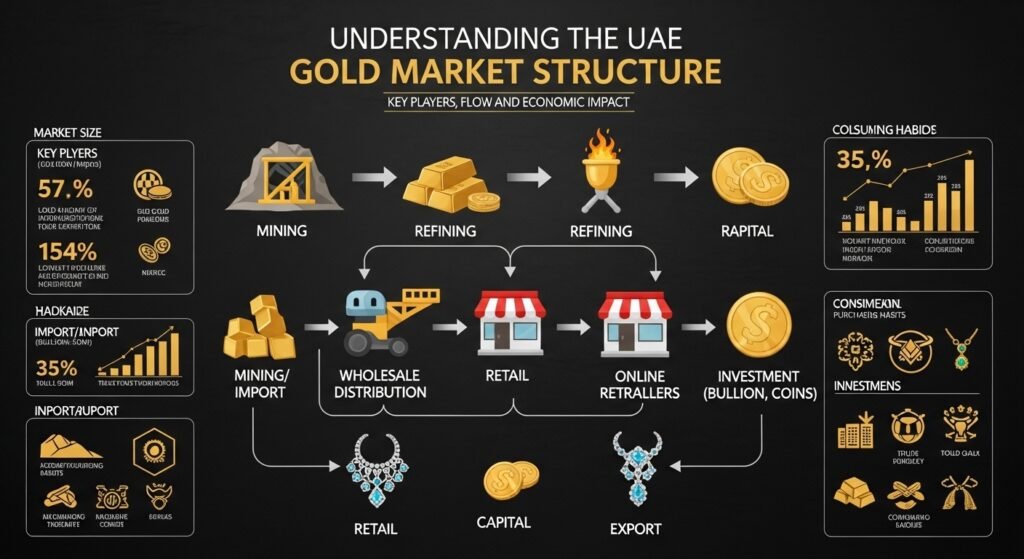
The UAE is widely recognized as one of the most important gold trading hubs in the world. Many investors who ask whether gold prices can crash in the UAE often overlook how strong and globally connected the UAE gold market actually is. The country has built a powerful ecosystem that includes international bullion traders, refineries, logistics hubs, and one of the largest retail jewelry markets in the Middle East. This strong structure keeps the market liquid and stable even when global prices fluctuate.
Dubai plays the central role in this ecosystem because it connects gold flows between Africa, Asia, and Europe. Large trading volumes, transparent pricing, and tax advantages have made the UAE one of the most trusted places to buy and trade gold. Anyone tracking daily movements can see this market activity through resources like the gold rate in UAE which reflects how quickly international price changes affect the local market.
Another reason the UAE gold market is so influential is the massive demand from tourists, investors, and expatriate communities. Seasonal buying during events like weddings and festivals also drives consistent demand across the country. This strong retail demand is closely linked with cultural buying patterns discussed in why Indians buy gold from Dubai, which explains why Dubai’s gold market attracts millions of buyers every year.

Dubai’s Role in Global Gold Trade
Dubai has become one of the most important gold trading centers globally. Estimates suggest that around 20 to 30 percent of the world’s gold trade passes through Dubai, making it a key link in the international bullion supply chain. Gold from African mines, European refiners, and Asian jewelry manufacturers often flows through Dubai before reaching final markets.
The scale of this trade is reflected in export figures. In 2024, the UAE exported approximately 58.7 billion dollars worth of gold, demonstrating how central the country has become in global precious metals commerce. This strong trade network supports price transparency and liquidity, which reduces the risk of sudden market disruptions.
Because the UAE market mirrors international pricing so closely, it is also important to understand how global rates affect local prices. The relationship between international spot prices and local retail rates is explained in detail in Dubai gold rate vs international gold price.
UAE Gold Trade Volume and Market Size
The UAE gold sector has grown significantly over the past decade, both in trading volume and market value. Dubai in particular has developed infrastructure that supports massive bullion transactions every year.
| Indicator | Value |
|---|---|
| Gold trade volume | ~1,945 tonnes |
| Market trade value | 225 billion AED in early 2025 |
| Global share | ~11% of world gold trade |
These figures highlight the scale of the UAE gold ecosystem. With nearly two thousand tonnes of gold passing through its markets and a trade value exceeding 225 billion AED, the UAE has positioned itself among the top global gold trading centers.
Such a large and liquid market also means prices are strongly linked to global movements rather than local speculation. This connection is one of the main reasons analysts closely monitor international economic signals when evaluating whether gold prices could fall or rise in the UAE.
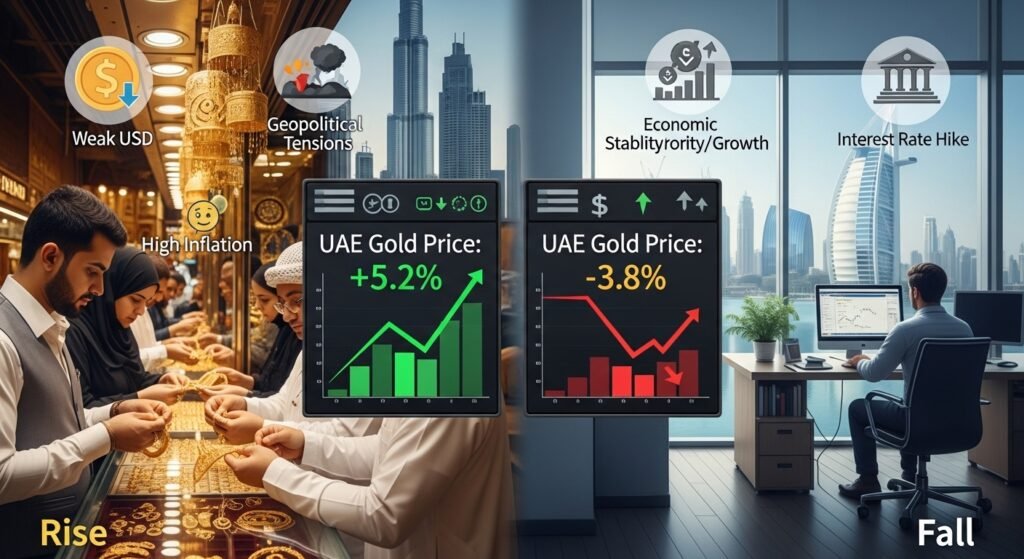
What Causes Gold Prices to Rise or Fall in the UAE
Gold prices in the UAE do not move randomly. They are influenced by several global economic factors that affect the international gold market first and then pass through to local UAE prices. Since the UAE gold market closely follows global bullion exchanges, even small changes in the world economy can push prices up or down within hours. Understanding these macroeconomic drivers helps buyers and investors make smarter decisions before purchasing gold.
Another important point is that the UAE gold market is highly transparent and globally connected. Prices in Dubai, Abu Dhabi, and other emirates respond almost instantly to international market movements. Anyone tracking daily updates through the gold rate in UAE can see how quickly global financial events influence local retail prices. Several economic factors consistently drive these changes.
Global Gold Spot Price Movements
The most powerful factor behind UAE gold prices is the global gold spot price. This price is determined by international bullion markets such as the London Bullion Market Association and major commodity exchanges. When the global spot price rises or falls, UAE gold prices adjust almost immediately.
Gold has experienced significant volatility in recent years. In January 2026, global gold prices reached an all time high of around 5608 dollars per ounce, reflecting strong demand from investors during economic uncertainty. When such global spikes occur, retail gold prices in Dubai jewelry markets increase within hours.
This close connection between international and local prices is explained further in Dubai gold rate vs international gold price, which shows how global bullion benchmarks influence UAE retail rates.
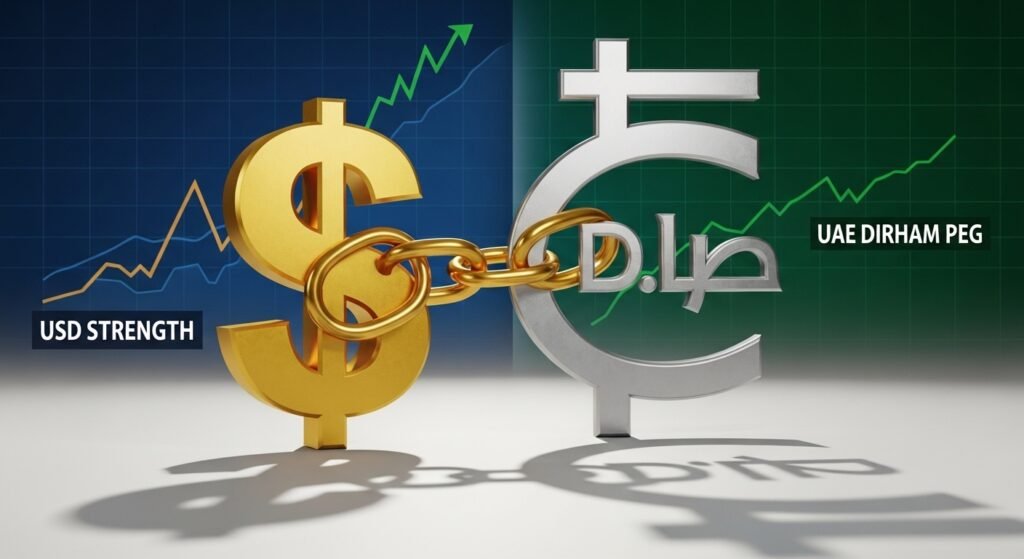
USD Strength and UAE Dirham Peg
Another key factor affecting UAE gold prices is the relationship between the US dollar and the UAE dirham. The UAE dirham is pegged to the US dollar, meaning its value moves closely with the dollar in international currency markets. Because gold is priced globally in dollars, any change in the dollar can influence gold prices in the UAE.
When the US dollar becomes stronger, gold often becomes more expensive for buyers using other currencies, which can reduce demand and sometimes push prices lower. When the dollar weakens, gold usually becomes more attractive as an alternative store of value. This relationship is discussed in detail in does USD affect gold price in UAE.
Inflation and Interest Rates
Inflation and central bank interest rate policies also play a major role in gold price movements. When inflation rises, many investors turn to gold as a hedge against currency depreciation. This increased demand pushes gold prices higher in global markets and eventually raises prices in the UAE.
However, higher interest rates can sometimes pressure gold prices. When central banks increase interest rates, investors may move funds into interest bearing assets like bonds instead of gold. As a result, gold demand can temporarily weaken and prices may decline.
Geopolitical Conflicts and Safe Haven Demand
Gold is widely considered a safe haven asset during global uncertainty. Political conflicts, wars, and economic crises often cause investors to move money into gold to protect their wealth. When global tensions increase, demand for gold rises sharply and prices typically surge.
Recent geopolitical tensions and global economic instability have pushed gold prices higher several times over the past few years. These sudden increases can also cause short term price spikes in UAE markets because local traders react quickly to international demand.
Supply and Mining Production
Gold supply also affects market prices, although supply changes usually influence prices more slowly than demand factors. Global gold production comes from mining operations and recycled gold entering the market.
If global mining output increases significantly, additional supply may put downward pressure on prices. However, gold production grows slowly each year because mining expansion requires large investments and long development timelines. This limited supply growth is one reason gold prices tend to remain stable over the long term.
For a deeper understanding of all market forces affecting gold prices locally, you can explore what affects gold price in UAE which explains the full range of economic and market drivers.
Historical Gold Price Trends in UAE (Data Analysis)
Looking at historical gold prices helps investors understand whether the market is likely to crash or simply experience temporary corrections. Gold in the UAE has followed a long term upward trend over the past decade, mainly driven by global inflation, geopolitical tensions, and strong investor demand. Even though prices fluctuate frequently in the short term, historical data shows that gold rarely experiences prolonged crashes because global demand and limited supply keep prices supported.
If you want to study these long term patterns in detail, the gold price history chart provides a clear view of price cycles, corrections, and rallies over the years. Historical analysis also helps buyers identify typical price ranges and understand how global events influence UAE retail gold markets.
UAE Gold Prices Over the Last 10 Years
Over the past decade, gold prices in the UAE have increased significantly as global economic uncertainty and inflation boosted demand for safe haven assets. The price growth accelerated especially after 2020 when global markets experienced high inflation and geopolitical instability.
Data from international gold price charts shows that gold has nearly doubled over the last five years in many markets due to increased investor demand and economic uncertainty.
Key historical observations include
• Gold prices in the UAE steadily increased from around 150 to 180 AED per gram in the mid 2010s
• Prices crossed 300 AED per gram during global economic disruptions
• By 2025 to 2026, prices moved beyond 600 AED per gram due to strong global demand
This long term growth trend demonstrates that gold behaves more like a cyclical asset than a highly volatile commodity.
2025 to 2026 Price Movement Example
Recent market movements provide a good example of how gold prices fluctuate in short cycles. During early 2026, UAE gold prices moved rapidly due to global market volatility.
| Date | 24K Gold Price (AED/g) |
|---|---|
| Jan 2026 | ~615 |
| Feb 2026 | ~636 |
| Mar 2026 | ~636 |
These changes show that prices can increase or decrease within weeks depending on global economic signals and investor sentiment. For example, historical data shows that 24K gold in the UAE traded around 615 AED per gram in February 2026 before fluctuating again due to international market movements.
Even daily price swings can be significant. In March 2026, gold prices in Dubai dropped about 10 AED per gram in a single day after reaching record highs, highlighting how sensitive the market can be to global developments.
Lowest vs Highest UAE Gold Prices in Recent Years
Examining recent highs and lows gives a clearer picture of market volatility and potential risk levels.
| Market Indicator | Price |
|---|---|
| Lowest price (2025) | ~403 AED per gram |
| Highest price (2026) | ~615 to 664 AED per gram |
Recent market data shows that the lowest 22K gold price in the UAE reached around 403 AED per gram in 2025, while the highest 24K gold price climbed to about 664 AED per gram in early 2026 during a strong market rally.
This wide price range demonstrates how gold moves through cycles rather than collapsing suddenly. Instead of a permanent crash, the UAE gold market typically experiences corrections followed by new growth phases. Understanding these patterns helps investors evaluate whether a price drop represents a risk or a potential buying opportunity.
Can Gold Prices Actually Crash in UAE
Many investors ask whether a sudden collapse in gold prices is possible, especially during periods of market volatility. When people ask Can gold price crash in UAE, they usually imagine prices falling dramatically within a short period. In commodity markets, a crash does not simply mean a small drop. It refers to a sharp and rapid decline caused by major economic or financial disruptions. Understanding what qualifies as a crash helps investors separate normal price corrections from real market collapses.
In reality, the gold market rarely experiences extreme crashes because it behaves differently from speculative assets. Gold has intrinsic value and global demand across jewelry, investment, and central bank reserves. While short term drops can happen, the long term trend of gold historically remains stable or upward. Investors who monitor the gold rate in UAE often notice that price declines are usually temporary corrections rather than permanent crashes.
What “Crash” Means in Commodity Markets
In commodities such as gold, analysts typically classify a crash based on the scale and speed of the price decline. These situations usually occur when multiple economic pressures hit the market at the same time.
Common crash scenarios include
Sharp market correction of 10 to 20 percent
This is the most common situation in the gold market. Prices may drop quickly after reaching record highs when investors take profits. For example, after strong rallies, gold sometimes declines temporarily as traders sell to lock in gains.
Market panic selling
Panic selling can happen when investors suddenly shift their money into other assets such as stocks or bonds. If large institutional investors begin selling gold simultaneously, prices can fall quickly for a short period.
Global recession or liquidity crisis
During severe economic downturns, investors sometimes sell gold to raise cash and cover financial losses in other markets. This can temporarily push prices down even though gold is normally considered a safe asset.
Why Gold Rarely Collapses Long Term
Despite occasional corrections, gold rarely experiences long term crashes because of strong global demand and limited supply. Central banks around the world hold large gold reserves and often increase purchases during economic uncertainty. Jewelry demand from major markets such as India, China, and the Middle East also provides steady consumption.
Another stabilizing factor is that gold production grows slowly. Mining companies cannot dramatically increase supply in a short time because new mines require years of investment and development. This natural supply constraint prevents sudden market oversupply that could collapse prices.
Gold also benefits from its reputation as a store of value during economic instability. During inflation, currency depreciation, or geopolitical conflict, investors often move funds into gold to protect their wealth. These long term demand drivers explain why gold prices may correct temporarily but rarely collapse permanently.
For investors studying long term price cycles, reviewing historical trends through the gold price history chart can provide valuable perspective on how gold markets behave during different economic periods.
7 Major Factors That Could Trigger a Gold Price Crash in UAE
Gold prices usually move gradually, but under certain economic conditions they can fall sharply within a short time. When people ask whether gold prices can crash in the UAE, the answer depends on global financial factors rather than local market issues. The UAE gold market follows international bullion prices very closely, which means global economic shifts can quickly influence local rates.
In practice, a true crash would require several economic pressures happening at the same time. Investors who regularly track the gold rate in UAE often notice that price drops are usually linked to global monetary policy, currency strength, and investor sentiment. Below are the major factors that could potentially trigger a sharp decline in gold prices.
1. Rapid Increase in Global Interest Rates
One of the strongest forces that can push gold prices down is a rapid increase in global interest rates. When central banks raise rates, investors often shift money into interest bearing assets such as government bonds or savings instruments. Since gold does not generate interest, it can become less attractive during high rate environments.
For example, if the US Federal Reserve significantly increases rates, global capital may move away from gold. This shift can cause gold prices to decline temporarily in international markets, which would also lower prices in UAE jewelry markets.
2. Strong US Dollar
Gold prices usually move inversely to the US dollar. When the dollar strengthens significantly, gold becomes more expensive for investors using other currencies. This can reduce global demand and push prices downward.
Because the UAE dirham is pegged to the US dollar, changes in dollar strength directly influence local gold prices. The relationship between the dollar and local gold rates is discussed further in does USD affect gold price in UAE which explains why currency movements matter for buyers in Dubai and other emirates.
3. Massive Gold Supply Increase
Gold supply growth can also affect market prices, although supply changes typically occur slowly. If large new gold mines begin production or if recycled gold floods the market, the additional supply can put pressure on prices.
However, gold supply rarely expands rapidly because mining projects require years of exploration, investment, and regulatory approvals. This limited supply growth is one reason why gold crashes are relatively rare compared with other commodities.
4. Global Economic Stability
Gold tends to perform best during economic uncertainty. When global economies become stable and stock markets perform strongly, investors may move money away from gold and into growth assets. This shift in investor sentiment can reduce demand for gold.
For instance, if inflation drops and global markets stabilize, many investors may prefer equities or real estate instead of holding gold. Reduced demand can lead to gradual price declines.
5. Reduced Investment Demand
Large institutional investors and exchange traded funds hold significant quantities of gold. If these investors begin selling their holdings due to market strategy changes, prices can fall quickly.
Investment demand often drives major price movements in the gold market. When investor sentiment weakens, selling pressure can temporarily outweigh physical demand from jewelry markets.
6. Government Policies and Import Regulations
Government regulations and tax policies can also influence gold demand in major buying countries. If large markets such as India or China introduce strict import duties or restrictions, global gold demand may decrease.
Since a large portion of UAE gold sales comes from international buyers and tourists, regulatory changes in major consuming countries can indirectly affect the UAE market. Buyers who compare regional prices often monitor markets like gold price in Saudi Arabia and gold price in Qatar to understand broader Gulf market trends.
7. Profit Taking After Record Highs
Profit taking is one of the most common reasons gold prices fall after reaching record highs. When gold prices rise sharply, many investors sell part of their holdings to secure profits.
For example, after gold surged above 4500 dollars in global markets during a previous rally, prices dropped shortly afterward as investors began selling to lock in gains. These corrections can cause noticeable short term declines in UAE gold prices.
Despite these possible triggers, most analysts believe that gold price crashes are uncommon because long term demand from central banks, investors, and jewelry markets continues to support the global gold market.
Factors That Prevent Gold Prices From Crashing
Even though gold prices can fluctuate in the short term, several strong demand drivers prevent the market from collapsing completely. These structural factors support gold prices globally and help stabilize markets like the UAE. Investors who study long term price patterns through the gold price history chart often notice that gold rarely experiences permanent declines because strong demand continues to return during every market cycle.
Another important point is that gold demand comes from multiple sources such as central banks, investors, and jewelry buyers. This diversified demand base acts as a natural stabilizer for the market. When one segment slows down, another usually increases buying, which helps prevent a long term crash in gold prices.
Central Bank Gold Buying
Central banks are among the largest buyers of gold in the global market. Many countries increase their gold reserves to diversify away from currencies and reduce financial risk. In recent years, central banks in Asia, the Middle East, and emerging economies have significantly increased their gold purchases.
When central banks buy large quantities of gold, they create strong base level demand that supports global prices. This institutional demand often absorbs excess supply during market downturns and prevents prices from collapsing.
Inflation Hedge Demand
Gold is widely viewed as a hedge against inflation. When inflation rises and purchasing power declines, many investors turn to gold to protect their wealth. This behavior increases demand for gold bars, coins, and exchange traded funds.
During periods of high inflation, gold demand tends to increase across many regions including the UAE. As a result, inflationary environments often support higher gold prices rather than causing crashes.
Jewelry Demand in UAE and Asia
Jewelry consumption is one of the largest sources of gold demand worldwide. In the UAE and many Asian countries, gold jewelry holds cultural and financial significance. Weddings, festivals, and family investments regularly drive large purchases of gold jewelry.
In fact, around 60 percent of UAE gold demand comes from jewelry purchases, which provides consistent market support. Seasonal buying patterns such as wedding seasons also play a role in boosting demand, which is discussed in wedding season gold demand UAE trends 2026.
Safe Haven Asset During Crises
One of the strongest reasons gold rarely crashes is its role as a safe haven asset. During financial crises, geopolitical conflicts, or economic instability, investors often move money into gold to protect their capital.
This flight to safety increases demand during uncertain times and pushes prices upward. Because global crises occur periodically, gold often benefits from repeated waves of investor demand. This long term pattern helps maintain stability in global gold markets and in the UAE retail market as well.
Short Term vs Long Term Gold Price Corrections
Gold prices in the UAE often move through cycles of growth and temporary declines. Many buyers worry when prices fall suddenly and assume the market is crashing. In reality, most price drops are normal market corrections rather than permanent collapses. Understanding the difference between a correction, a bear market, and a crash helps investors interpret price movements more accurately.
If you regularly monitor the gold rate in UAE, you will notice that short term fluctuations are common because global markets react to economic data, currency movements, and investor sentiment. These short term changes do not necessarily signal a long term decline in gold prices.
Types of Gold Market Declines
Gold analysts generally categorize market declines into three main levels depending on the size of the price drop.
| Market Move | Typical Drop |
|---|---|
| Correction | 5 to 15 percent |
| Bear market | 20 to 40 percent |
| Crash | 40 percent or more |
A correction is the most common scenario. Prices may drop slightly after reaching a peak because investors sell to secure profits. These movements are usually temporary and often followed by a new upward trend.
Historical Examples of Gold Price Corrections
Historical gold market data shows that corrections happen regularly but rarely turn into full crashes. For example, during global economic uncertainty in the early 2020s, gold prices surged to record levels and then briefly corrected before continuing their upward trend.
In some cases, prices can enter a bear market when multiple economic pressures reduce demand. For instance, when interest rates increase significantly and the US dollar strengthens at the same time, gold prices may fall more sharply for a period.
However, long term historical data still shows that gold has generally recovered after major corrections. Reviewing long term trends through the gold price history chart helps investors see how the market moves through cycles rather than collapsing permanently.
Understanding these market patterns allows buyers and investors in the UAE to evaluate whether a price drop represents risk or a potential opportunity to purchase gold at lower levels.
Expert Forecasts for Gold Prices in UAE
Understanding expert forecasts can help investors evaluate whether gold prices in the UAE are likely to rise, stabilize, or fall in the coming years. Because the UAE gold market follows international bullion prices closely, most forecasts are based on global macroeconomic trends such as inflation, central bank policies, currency movements, and geopolitical tensions. Analysts generally agree that gold may remain volatile in the short term but is expected to maintain strong long term demand.
Many investors in the UAE track forecasts alongside live market updates such as the gold rate in UAE to decide when to buy or sell. Forecasts should not be viewed as exact predictions, but they provide useful guidance based on economic indicators and historical market behavior.
2026 Gold Price Forecast
Most financial institutions expect gold prices to remain strong in 2026 due to global economic uncertainty and continued central bank demand. Several analysts believe gold may trade above five thousand dollars per ounce during periods of high demand and market volatility.
For example, global macro models estimate that gold could trade around about 5,152 dollars per ounce by the end of the current quarter under current economic conditions.
Some investment banks have issued even more bullish forecasts. JPMorgan has projected that gold could reach around 6,300 dollars per ounce by the end of 2026, driven by strong central bank buying and growing diversification away from the US dollar.
Other analysts also expect high volatility in the market. Some projections estimate that gold prices could fluctuate widely between about 4,900 and more than 11,000 dollars per ounce depending on geopolitical developments and monetary policy decisions.
For UAE buyers and investors, these forecasts suggest that gold prices may continue to move within wide ranges rather than collapsing suddenly.
If you want a deeper analysis of future price expectations, the detailed outlook in gold rate forecast 2026 UAE explains potential scenarios for the regional market.
Long Term Forecast (2030 and Beyond)
Long term gold forecasts generally remain optimistic because several structural trends support demand. These include rising global debt levels, currency diversification by central banks, geopolitical tensions, and increasing demand for safe haven assets.
Some long term projections suggest that gold prices could gradually rise toward around 6,000 to 7,000 dollars per ounce by 2030 under strong economic uncertainty scenarios.
Other models estimate that gold could average around 5,000 dollars per ounce by 2030 if current macroeconomic conditions continue.
These long term predictions are not guaranteed outcomes, but they show that most analysts do not expect a permanent crash in gold prices. Instead, the market is likely to move through cycles of corrections and growth.
For investors in the UAE, this means short term price drops may occur, but the overall long term outlook for gold remains supported by strong global demand and economic uncertainty.
Impact of a Gold Price Crash on UAE Investors and Buyers
If gold prices were to drop sharply, the effects would be felt across different groups in the UAE gold market. Dubai and other emirates have one of the largest retail and trading gold ecosystems in the world, so price movements influence jewelry buyers, investors, traders, and tourism driven retail markets. However, the impact of a price crash would not be entirely negative because lower prices could also create new buying opportunities.
For people who regularly monitor the gold rate in UAE, sudden price drops may initially create uncertainty. But in reality, many buyers and investors treat price declines as a chance to accumulate gold at lower levels. The impact varies depending on how gold is used by different participants in the market.
Gold Jewelry Buyers
For jewelry buyers, a drop in gold prices would generally be positive. Lower prices reduce the cost of necklaces, bangles, and other jewelry pieces, making gold more affordable for consumers.
In the UAE, jewelry demand increases significantly during wedding seasons and festivals. Lower prices could lead to higher purchasing activity, especially among tourists and expatriate communities. Cultural buying patterns and seasonal demand trends are discussed in wedding season gold demand UAE trends 2026 which shows how demand often rises when prices fall.
Gold Bar Investors
For investors holding gold bars or coins, a sudden price drop could temporarily reduce the value of their holdings. Short term investors might face losses if they purchased gold near peak prices.
However, long term investors often see price corrections as an opportunity to buy more gold at lower prices. Many experienced investors use strategies such as gradual accumulation to manage price volatility. Investors who want to estimate potential purchase values often use tools like the gold price calculator Dubai to calculate costs based on weight and purity.
UAE Gold Traders
Gold traders and jewelers in the UAE experience mixed effects during price declines. On one hand, falling prices can reduce the value of existing inventory held by retailers. On the other hand, lower prices often increase sales volume as more customers enter the market.
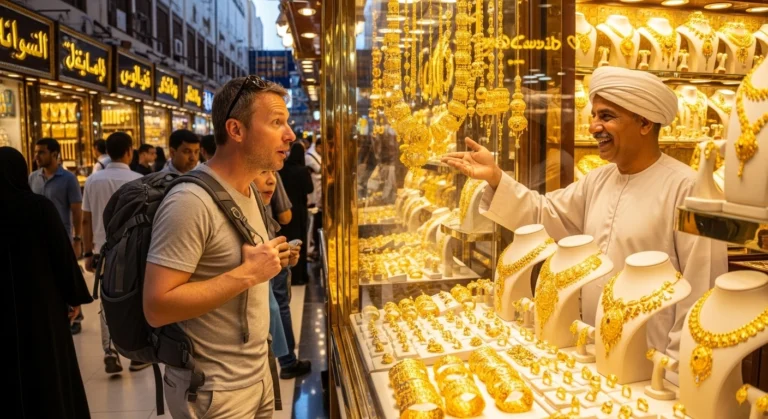
Retailers in popular markets such as Dubai Gold Souk usually see higher foot traffic when prices decline because buyers view it as a good opportunity to purchase gold.
Tourism and Retail Markets
Tourism plays a significant role in the UAE gold market, especially in Dubai. Many visitors travel specifically to buy gold due to competitive prices and lower taxes compared with other countries.
If gold prices drop globally, the UAE retail sector could experience an increase in international buyers. Tourists from countries such as India often compare price differences before purchasing. This comparison is explored further in gold price UAE vs India which explains why many travelers consider buying gold in Dubai.
Overall, while a sharp price drop may create temporary uncertainty for investors, it can also stimulate demand from jewelry buyers and tourists, which helps stabilize the UAE gold market over time.
Should Investors Buy Gold in UAE During Price Volatility
Gold prices often move up and down due to global economic events, which can make investors uncertain about the right time to buy. Many people hesitate when prices fluctuate because they fear purchasing at the wrong moment. However, experienced investors understand that volatility is normal in commodity markets. Instead of trying to predict exact price movements, they usually follow structured strategies that reduce risk and improve long term investment outcomes.
For investors in the UAE, tracking daily market movements through the gold rate in UAE can help identify trends and price cycles. Rather than reacting emotionally to short term fluctuations, investors often rely on disciplined strategies that focus on long term value and gradual accumulation.
Dollar Cost Averaging Strategy
Dollar cost averaging is one of the most widely used strategies for investing in gold during volatile markets. This approach involves purchasing gold in small amounts at regular intervals instead of making a large purchase at once.
By buying consistently over time, investors reduce the risk of purchasing gold at a temporary market peak. If prices fall, the investor can buy additional gold at lower prices, which helps balance the overall average purchase cost. This strategy works well in markets like the UAE where gold prices update frequently throughout the day.
Buying During Market Corrections
Market corrections can create valuable opportunities for investors. When gold prices drop due to short term factors such as profit taking or currency fluctuations, many investors view these declines as attractive entry points.
For example, if prices fall by five to fifteen percent during a correction phase, buyers may be able to purchase gold at lower levels before the next upward trend begins. Understanding when prices are temporarily discounted can help investors build their gold holdings more efficiently.
Investors often analyze market patterns and price cycles before making such decisions. Insights on timing strategies are explained further in best time to buy gold in UAE which highlights periods when gold demand and pricing conditions are more favorable.
Diversifying Gold Investments
Diversification is another important strategy for managing gold investments. Instead of holding only one form of gold, investors often spread their holdings across different formats such as jewelry, gold bars, coins, or digital gold products.
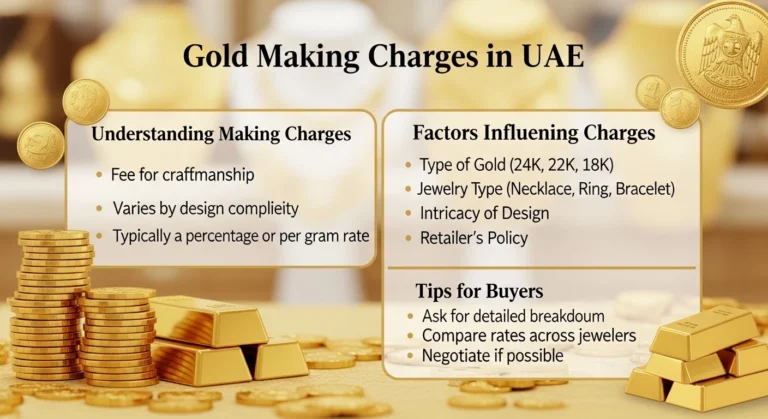
Diversification can reduce risk because each type of gold investment behaves slightly differently in the market. For instance, jewelry may carry making charges while bullion is priced closer to the international gold rate. Understanding these cost differences is explained in gold making charges in UAE explained which helps buyers evaluate the real cost of gold purchases.
By combining disciplined buying strategies with long term market awareness, investors in the UAE can navigate gold price volatility more confidently while building a balanced and resilient portfolio.
UAE Gold Market Outlook (2026–2030)
The future of the UAE gold market looks strong as several economic and structural factors continue to support growth. Dubai has already established itself as one of the world’s leading gold trading centers, and ongoing developments in infrastructure, global trade connections, and investment demand are expected to strengthen its position further. While short term price fluctuations will continue, most analysts believe the UAE gold market will remain active and resilient through the rest of this decade.
Investors and buyers who track long term trends through tools like the gold price history chart can see that gold demand in the region has consistently grown over time. Future demand will likely be driven by expanding trade networks, rising global uncertainty, and increasing interest from international investors.
Dubai Gold District Development
One of the most important developments shaping the future of the UAE gold market is the expansion of the Dubai Gold District. This project aims to create a large integrated ecosystem for gold trading, refining, and retail activity. The district is designed to attract international bullion traders, jewelry manufacturers, and global investors.
As the infrastructure improves, Dubai is expected to strengthen its role as a major gateway for gold flowing between Africa, Asia, and Europe. Increased trade activity within the district could lead to higher market liquidity and stronger price transparency in the regional gold market.
Growing Global Demand
Global demand for gold is expected to remain strong in the coming years due to economic uncertainty and growing investment interest. Central banks across several countries have increased their gold reserves in recent years as part of efforts to diversify away from traditional currencies.
Jewelry demand in regions such as the Middle East and Asia is also expected to grow steadily. Cultural buying patterns, weddings, and festival related purchases continue to drive strong consumer demand in these regions. For example, seasonal demand patterns are often observed during events such as Ramadan and Eid, which are discussed in gold price during Ramadan in UAE.
Financial Market Instability
Financial market instability is another factor that could strengthen gold demand in the coming years. Global inflation concerns, rising government debt levels, and geopolitical tensions often push investors toward safe assets like gold.
During periods of economic uncertainty, gold tends to attract investment flows as a store of value. This pattern has been observed repeatedly during financial crises and global economic disruptions. Because the UAE gold market closely follows international bullion prices, global financial instability could continue to support higher gold prices in the region.
Overall, between 2026 and 2030 the UAE gold market is expected to benefit from strong global demand, expanding trade infrastructure, and continued investor interest in gold as a long term asset.
FAQs About Gold Prices in UAE
Understanding gold price movements often raises common questions among buyers, investors, and tourists in the UAE. The answers below address the most frequent concerns about price fluctuations, investment safety, and buying strategies. These insights are based on how the global bullion market works and how it influences the UAE gold market.
Can gold price crash in UAE overnight
A complete gold price crash in the UAE overnight is extremely unlikely. Gold prices in the UAE are linked directly to international bullion markets, so changes usually happen gradually rather than collapsing suddenly.
Short term drops can occur due to global economic news, currency movements, or investor profit taking. However, large crashes usually require major global financial disruptions. Buyers who track the gold rate in UAE can see that prices typically fluctuate in small steps throughout the day rather than collapsing suddenly.
Why is gold cheaper in Dubai
Gold is often cheaper in Dubai because the UAE has lower taxes and strong competition among gold retailers. Unlike many countries, the UAE does not impose heavy import duties on gold, which helps keep prices closer to international market rates.
Dubai also has one of the largest gold trading hubs in the world, which increases supply and price transparency. The reasons behind this price difference are explained in detail in why gold cheaper in Dubai than India.
Is gold a safe investment in UAE
Gold is generally considered a relatively stable investment because it has intrinsic value and strong global demand. Investors often use gold as a hedge against inflation and currency fluctuations.
While gold prices can fluctuate in the short term, the long term historical trend shows gradual appreciation. Many investors include gold as part of a diversified portfolio to reduce financial risk during economic uncertainty.
When is the best time to buy gold in Dubai
The best time to buy gold in Dubai usually depends on market cycles and seasonal demand. Prices tend to fluctuate with global gold markets, so buying during temporary corrections can often provide better value.
Seasonal promotions and shopping festivals can also offer good buying opportunities because retailers sometimes reduce making charges or provide special deals. Timing strategies for buyers are explained further in best time to buy gold in UAE.
Final Verdict: Is a Gold Price Crash in UAE Likely
After analyzing global market trends, historical price data, and economic drivers, a complete gold price crash in the UAE appears unlikely under normal conditions. The UAE gold market is deeply connected to the global bullion system and supported by strong demand from investors, central banks, and jewelry buyers.
Short term corrections are possible and occur regularly when investors take profits or when interest rates rise. These corrections usually range between five and fifteen percent and are considered normal market behavior.
A full scale crash would likely require a major global financial event such as severe economic instability, large scale liquidation of gold reserves, or a sudden collapse in global demand. Even in such scenarios, gold often recovers because investors tend to return to it as a safe store of value.
Overall, the UAE gold market remains resilient due to strong international demand, stable trading infrastructure, and continuous investor interest. For most buyers and investors, understanding market cycles and monitoring price trends provides a better strategy than worrying about sudden crashes.