Why Is Gold Cheaper in Dubai Than India? 4 Structural Reasons Explained
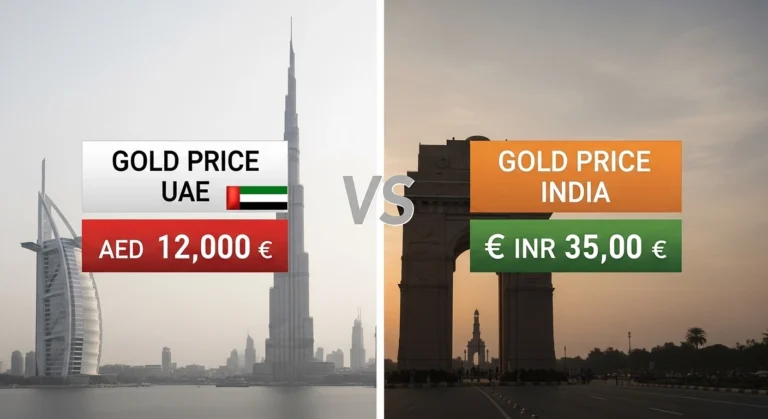
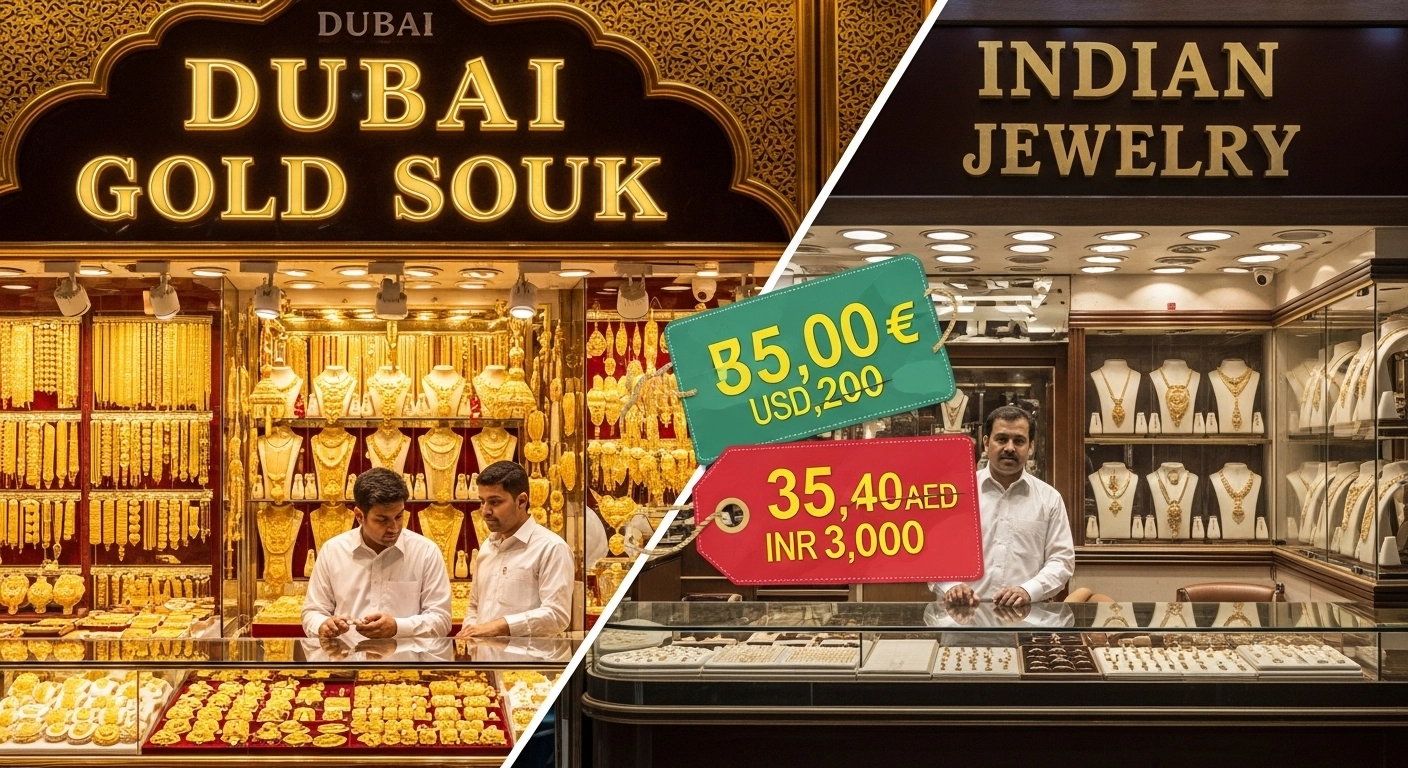
The price gap between Dubai and India gold isn’t a fluke or marketing. It’s built into the structure of both economies, and it isn’t going away. Here are the four permanent factors that make gold cheaper in Dubai.
1. India’s Import Duty: The Single Biggest Factor
India produces almost no gold domestically but consumes 700–900 tonnes a year. To protect its foreign exchange reserves, the government charges a 15% basic customs duty on gold imports, plus 3% GST on jewellery — an effective tax load of roughly 18% on jewellery purchased in India. This duty is baked into every gram sold at every Indian jeweller, branded or not.
Dubai charges 5% VAT on gold jewellery and zero import duty. The UAE is a free-trade entrepôt — gold flows in from Switzerland, South Africa, and Australia without tariffs. That 10–13 percentage point tax difference is the dominant reason for the price gap, full stop.
2. Making Charges: Competition Compresses Margins
The Dubai Gold Souk in Deira has over 380 shops within walking distance of each other. That level of competition keeps making charges at the absolute floor. Standard jewellery in Dubai’s souq carries making charges of AED 3–8 per gram for simple designs. Complex hand-crafted pieces run higher, but the baseline is far lower than India.
Indian jewellery retail — even large chains like Tanishq, Malabar, and Kalyan — operates with making charges of 10–25% of the gold value, partly because their cost structures are higher, and partly because consumers have fewer options within a short physical distance. Wedding jewellery in India routinely carries 18–22% making charges on top of the already duty-inflated gold price.
3. The Dollar Peg Eliminates Currency Risk
Gold is priced globally in US dollars. The UAE dirham has been hard-pegged to the USD at 3.6725 since 1997 — it has never moved. AED gold prices directly mirror the international spot price with no currency distortion.
The Indian rupee is a floating currency. When the rupee weakens — which it has done consistently, from ~₹45/USD in 2007 to ~₹85/USD in 2025 — gold prices in INR rise even if the global spot price stays flat. Indian buyers have effectively been paying a compounding currency depreciation premium on gold for two decades. This isn’t a buying-decision factor, but it explains why gold “feels” more expensive in India over long periods.
4. Verified Purity With Less Friction
The UAE mandates government hallmarking on all gold sold. 22K in Dubai is 91.6% pure, every time, verified by an independent UAE assay office. India’s BIS hallmarking system has improved dramatically since 2021 when it became mandatory for large retailers, but the unorganised sector still operates with inconsistent standards in parts of the country.
Better purity assurance at a lower tax rate is a hard combination to beat. It’s why Indian tourists rank the Gold Souk among Dubai’s top visitor experiences — they’re not just sightseeing, they’re shopping with purpose.
To see the actual price difference in numbers right now, check our UAE vs India live gold price comparison. To calculate your exact saving on a specific weight, use the Dubai gold price calculator. For customs rules on bringing gold back to India, see how much gold you can carry from Dubai to India.