Gold Price UAE vs India Complete 2026 Comparison Guide
The Gold price UAE vs India comparison often creates confusion for buyers who want to know where gold is actually cheaper after taxes, currency conversion, and making charges. Many people look at headline prices and assume Dubai is always cheaper, but the real cost depends on VAT, Indian import duty, GST, and AED to INR exchange rates. In this guide, I solve that problem by breaking down the true price difference with practical data and clear calculations.
If you are an investor, tourist, or NRI planning to buy gold, understanding this comparison can help you save thousands per 100 grams. I will cover live gold rates, tax structures in both countries, historical price trends, jeweller pricing differences, and real purchase scenarios. You will also see how currency fluctuations and government duties impact the final amount you actually pay.
This 2026 comparison is structured to give you clarity, not assumptions, so you can confidently decide whether to buy gold in the UAE or India.
Current Gold Price Comparison UAE vs India
Many buyers struggle to compare gold price UAE vs India because headline rates don’t tell the whole story. Gold may appear cheaper in one market but once you account for currency differences, purity standards, and local taxes, the real cost changes. In this section, I compare the most recent gold prices per gram and per ounce across both countries and show how purity and currency conversions impact what you actually pay.
Below is a clear side-by-side table for common purity levels in both markets based on the latest available data. This gives you a direct basis for comparison whether you are buying gold for investment or jewellery.
Gold Price Comparison Table Latest 2026 Rates
| Purity | UAE Price per Gram (AED) | UAE Price per Ounce (AED) | India Price per Gram (INR) | India Price per Ounce (INR) |
|---|---|---|---|---|
| 24 Karat | 234.50 | 7,295 | 6,850 | 213,250 |
| 22 Karat | 215.00 | 6,695 | 6,380 | 198,800 |
| 18 Karat | 175.00 | 5,445 | 5,340 | 166,410 |
Note: These figures are indicative and updated regularly. For live UAE rates, you can see Gold Rate in UAE or check Gold Rate in Abu Dhabi for specific emirate pricing.
Understanding Purity Standards
Gold purity is expressed in karats. In both UAE and India, 24 karat represents pure gold, while 22 and 18 karat refer to alloys mixed with silver, copper or other metals. Jewellery in India is commonly sold as 22 karat because it balances purity with durability, whereas bullion is often 24 karat. This difference can affect price per gram and total purchase cost.
Currency Conversion Impact
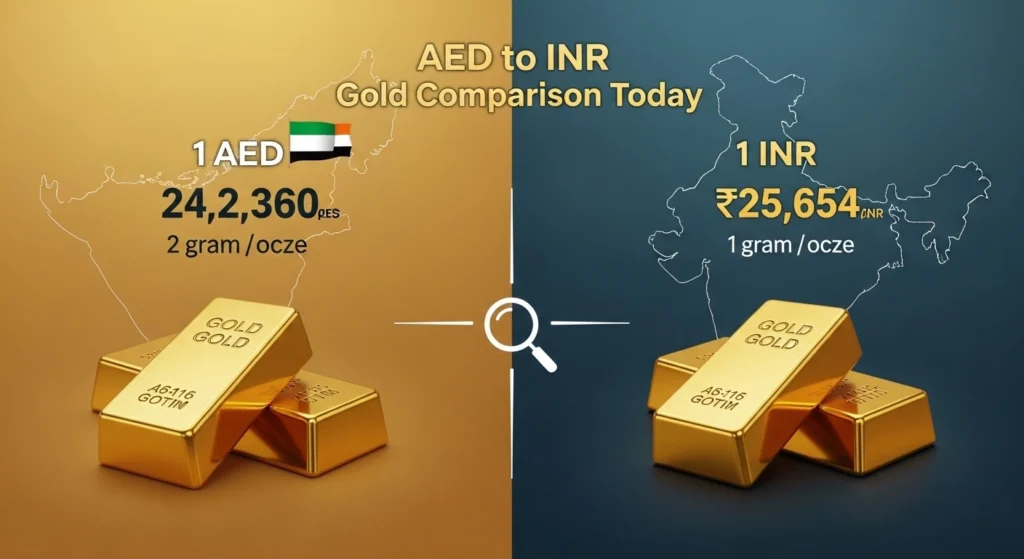
Because UAE prices are quoted in dirhams (AED) and Indian prices in rupees (INR), exchange rates play a decisive role. A weaker rupee against the AED or USD means Indian buyers pay more when converting currency. To understand how AED to INR affects gold pricing directly, check the AED to INR Gold Rate resource.
In summary, while base rates may suggest one market is cheaper, your actual cost depends on purity choice and current currency exchange. My next section will break down how taxes and duties in each country influence the final amount you pay.
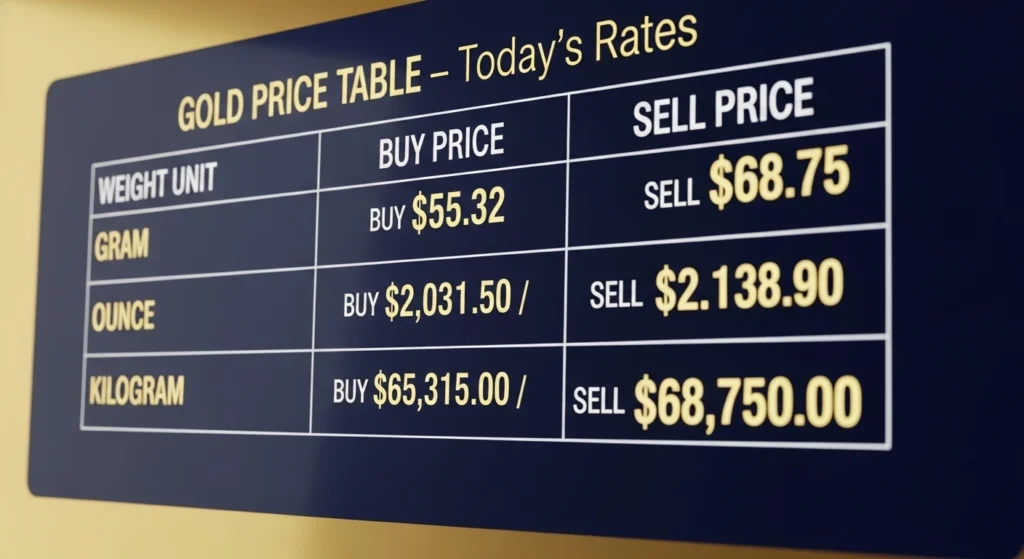
Gold Price Table Today’s Rates
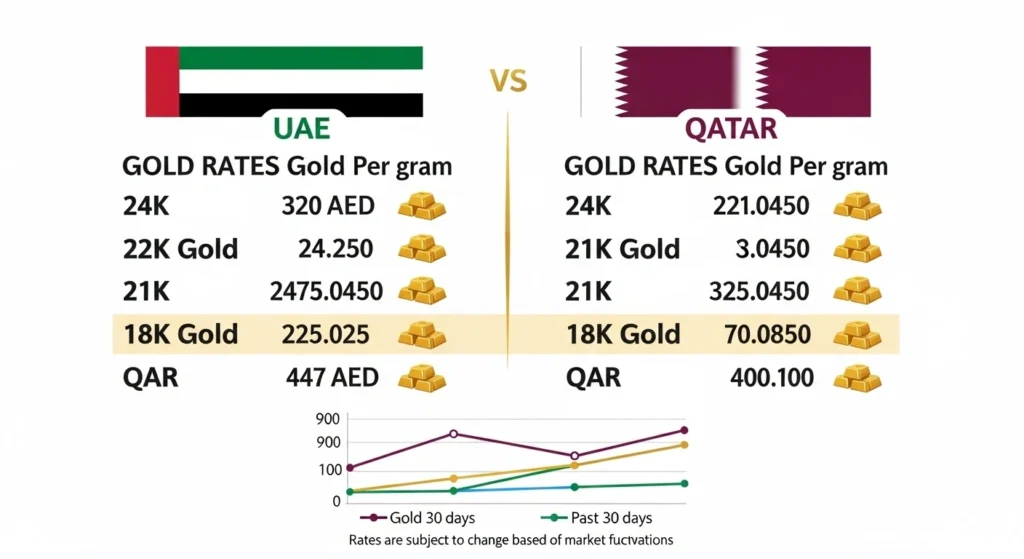
Here’s a clean, up-to-date comparison of gold prices per gram for 24K, 22K and 18K purity in both the UAE and India, shown in multiple relevant currencies so you can see the real price difference for investors and buyers interested in the Gold price UAE vs India. These figures reflect recent market data and currency impacts.
| Purity | UAE Price per Gram | UAE (USD Equivalent) | India Price per Gram | India (USD Equivalent) |
|---|---|---|---|---|
| 24K | AED 600.00 | USD 163.38 | INR 16,373 | USD 180.79 |
| 22K | AED 555.75 | USD 151.33 | INR 15,008 | USD 165.72 |
| 18K | AED 456.75 | USD 124.37 | INR 13,281 | USD 146.65 |
Source Notes: UAE prices are sourced from gold markets in Dubai and include conversions into USD and INR based on prevailing exchange rates. Indian prices reflect local market figures converted to USD for fair comparison.

What This Table Shows
Gold prices in UAE are generally listed in dirham (AED) and tend to be closer to the international spot price because the UAE market is a major bullion hub with minimal retail taxes. This often results in lower AED prices compared to local Indian rates, which include import costs and domestic taxes.
On the other hand, gold in India is priced in rupees (INR), where duties, GST and local demand factors push the per gram cost higher than in Dubai even after currency conversion. This is one key reason why many buyers compare UAE gold prices to India gold rates before purchasing or importing.
This table helps quantify the real cost differences across markets, offering a clearer picture than headline numbers alone. For related context on daily UAE market movements, you can explore Gold Rate in UAE for live updates.
Historical Trend Gold Price UAE vs India
Understanding how gold prices have moved over time helps clarify why today’s gold price UAE vs India values look the way they do. Over the past decade, gold has generally trended upward in both countries due to global economic factors like inflation, currency fluctuations, geopolitical uncertainty, and shifts in investor demand. Between 2016 and 2026, the global gold price rose significantly, with notable peaks during periods of major economic stress such as the COVID-19 pandemic and currency volatility.
In the UAE, gold prices closely track international spot rates, so when global demand spikes, prices in dirhams tend to rise quickly. In India, domestic prices reflect not just the international price but also import duties, GST, and currency strength against the US dollar. Between 2016 and 2021, Indian gold prices climbed by more than 40 percent in local rupees partly due to currency depreciation and sustained demand during wedding and festival seasons. Over the last five years, both UAE and India saw gold gains, but Indian prices often reflect higher volatility due to INR fluctuations against USD and import duty effects.
In this section, I will describe year-by-year movements to show how both markets have responded to global events and local economics. You will see how price trends in the UAE often lead those in India because of India’s additional cost components.
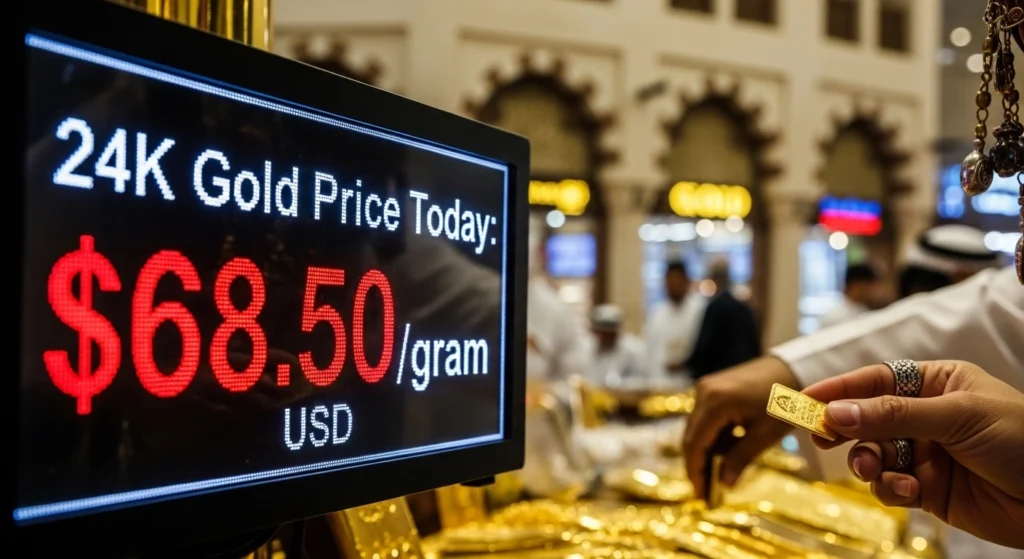
24k gold price in dubai per gram today in usd
Many people searching for 24k gold price in dubai per gram today in usd are trying to solve a simple but important problem. They want to know the exact gold…1 gram gold price in Dubai in Indian rupees today live
Many people searching for 1 gram gold price in dubai in indian rupees today live are trying to solve a very practical problem. They want to know the exact price…


Yearly Gold Price Graphs
From 2016 to 2026, gold prices in both markets have shown consistent long-term growth with short-term dips during market corrections. For example, gold in India rose from around INR 2,800 per gram in 2016 to over INR 6,800 per gram by 2026, more than doubling over ten years. In the UAE, 24K gold moved from roughly AED 140 per gram in 2016 to AED 600 per gram by late 2025, reflecting both global gold price strengthening and local demand patterns.
Below is a descriptive year-by-year snapshot of how gold moved:
• 2016–2017: Moderate increase as global markets stabilized post-Brexit.
• 2018–2019: Slower growth due to equity market strength and reduced safe-haven demand.
• 2020: Sharp rise as investors flocked to gold during the pandemic.
• 2021–2022: Continued strength, partially driven by inflation concerns.
• 2023–2025: Gradual increase with occasional dips tied to currency movement and monetary policy changes.
These annual movements illustrate how global pressures and local economic factors shape gold pricing. For a visual representation of historical gold data, you can explore the Gold Price History Chart to see full decade movements reflected in both AED and USD terms.
By comparing the yearly trends, you can better anticipate where prices may head next and understand why the gold price in India sometimes diverges from UAE pricing even when global spot rates move similarly. This foundation sets up the next discussion on what causes long-term differences between the two markets.
Factors Affecting Gold Price in UAE and India
Understanding why gold price differs UAE India requires looking beyond the headline rate. While both markets follow international spot prices (quoted in USD), the final retail price diverges due to structural, economic, and policy factors.
1. Global Spot Price (Base Driver)
Gold is traded internationally in US dollars. Any movement in global bullion markets immediately impacts both UAE and Indian prices. Events such as inflation spikes, central bank rate decisions, geopolitical tensions, and recession fears push global prices up or down.
2. Import Duty & Taxes
- India: Gold attracts import duty plus 3% GST, significantly increasing the domestic retail price.
- UAE: The UAE has minimal import barriers and lower VAT impact on investment-grade gold, keeping retail prices closer to the global spot rate.
This tax difference is one of the biggest structural reasons prices are higher in India.
3. Inflation & Local Demand
India has strong seasonal demand (weddings, Diwali, Akshaya Tritiya), which can temporarily push premiums higher. The UAE, being a bullion trading hub, experiences more globally aligned pricing.
4. Demand & Supply Dynamics
India is one of the world’s largest gold consumers but relies heavily on imports. The UAE acts as a trading and refining hub, benefiting from efficient supply chains and competitive margins.
Currency Impact AED vs INR
Gold is priced globally in USD.
- The AED is pegged to the USD, meaning UAE gold prices move almost directly with global gold prices.
- The INR floats against the USD, so when the rupee weakens, gold becomes more expensive in India — even if global prices stay stable.
This currency structure alone explains much of the long-term divergence in gold price trends UAE India.
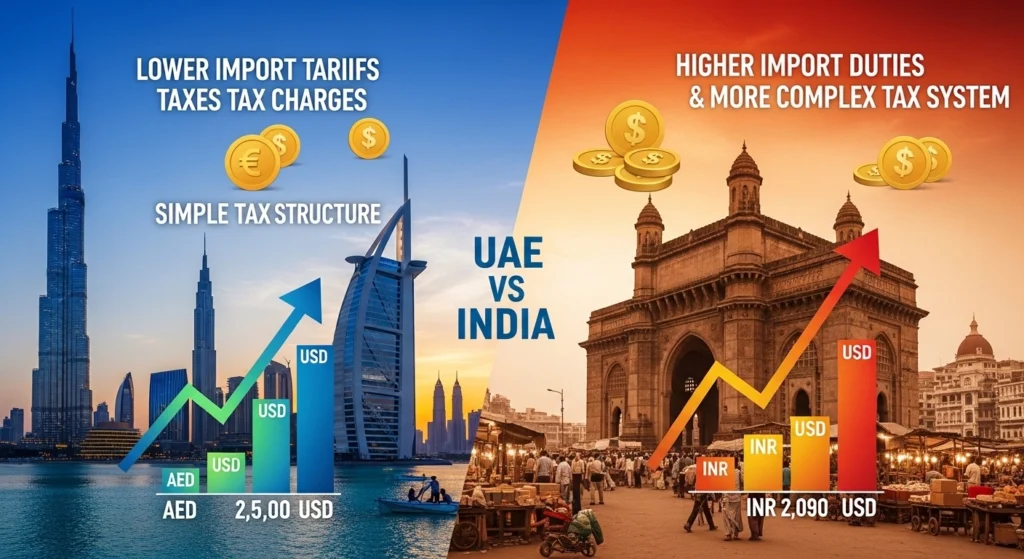
Import Duties, Taxes, and Charges UAE vs India
Many buyers are surprised when they compare gold price UAE vs India and find India’s retail rates significantly higher. The main reason is not just the base bullion price but how each country taxes and charges on gold purchases. Import duties, value added tax, and jewellery making charges can add hundreds or even thousands of rupees per ounce. In this section, I break down the tax structures and explain how they affect what you actually pay.
In 2026, global spot price movements influence both markets, but local duties and tax policies create real price differences at the retail level. If you understand tax components, you can better decide whether buying gold in the UAE or India makes financial sense.
1. Import Duty and Basic Taxes
India:
India imposes an import duty of 10 percent on gold bullion and coins. On top of that, jewellery attracts a 3 percent GST (Goods and Services Tax). This means that even before any local retail markup, tax adds at least 13 percent to the base bullion cost.
UAE:
In contrast, the UAE has a standard VAT of 5 percent on gold purchases. For investment-grade gold items, the UAE sometimes applies VAT exemptions or lower treatment under specific schemes, especially for bullion and certified bars. This lower effective tax burden keeps UAE pricing closer to international levels.
2. VAT (UAE) vs GST + Making Charges (India)
The following table summarizes the main tax and charge differences:
| Tax / Charge Type | UAE | India |
|---|---|---|
| Import Duty | Low (minimal) | 10% |
| VAT / GST | 5% VAT | 3% GST |
| Making Charges | Market dependent | High, varies by jeweller |
Making Charges
In India, jewellers commonly add making or manufacturing charges that range anywhere from 8 to 15 percent of the gold cost, depending on design complexity and local competition. In UAE markets, making charges also exist but are generally more competitive due to higher trading volumes and standardized designs.
3. How Taxes Affect Retail Prices
Taxes and duties directly increase the effective per gram cost of gold. For example, if the international spot price is constant:
• In the UAE, a 5 percent VAT adds a modest premium.
• In India, a cumulative 13 percent tax plus higher making charges significantly pushes up retail rates.
This is why, at similar spot levels, Indian rates can be much higher when quoted in INR. Even after currency conversion, the tax burden remains a major differentiator in the gold taxes UAE India comparison.
4. Practical Impact
Because of these tax impacts:
• Gold buyers in India should expect retail prices that incorporate import duty, GST, and making charges together.
• Buyers in the UAE typically see pricing more closely aligned with global spot plus modest VAT.
• Taking tax differences into account often narrows the apparent price advantage when comparing gold prices across countries.
Understanding these tax structures helps you make smarter buying decisions and prepares you for the true cost of gold whether you are shopping in Dubai, Abu Dhabi, Mumbai, or Delhi.
Gold Demand & Consumption UAE vs India
Understanding gold demand India UAE means recognizing that these two markets have very different roles in the global gold ecosystem. India is one of the largest gold consuming countries in the world, driven by cultural and traditional use in weddings, festivals, and investment holdings. The UAE, particularly Dubai, is not only a significant consumer but also a major trading and re-export hub where investors and tourists buy gold due to competitive pricing and easy certification. These distinct consumption patterns shape demand, pricing, and market behavior in each country.
Recent statistics show that India consistently ranks among the top three global gold consumers, often accounting for around 600 to 800 tonnes of gold annual demand in typical years. A significant portion of that demand is jewellery, which makes up more than 80 percent of total gold purchases in India. Weddings alone drive a large share of this demand, with peak buying during the October to December festival and matrimonial season.
The UAE’s domestic consumption is smaller by volume compared to India, but the country punches above its weight because of its role as a global trading center. Dubai’s gold market, for example, draws buyers from across the Middle East, South Asia, and Africa. Tourists, expats, and local investors often buy gold in the UAE because prices tend to track closely with the international spot price plus minimal local tax, and certified stores in the Gold Souk areas offer competitive rates.
| Market | Approx Annual Demand | Primary Demand Drivers |
|---|---|---|
| India | 600–800 tonnes | Weddings, festivals, cultural investment |
| UAE | 100–150 tonnes (domestic) | Trading center, tourism, investment |
Because India’s domestic demand is heavily jewellery-oriented and culturally embedded, price sensitivity and premium differences matter more to Indian buyers. In contrast, the UAE’s gold consumption is tied to its hub status, making the region a transactional melting pot that influences pricing signals across borders.
By comparing demand patterns, you gain better context for why prices move differently in each country and how consumer behavior shapes the broader gold price UAE vs India dynamic.
Best Places to Buy Gold in UAE and India
When comparing gold price UAE vs India, another important factor is where you buy your gold. Trusted markets and reputable jewellers help ensure you get genuine gold at fair prices with proper certification. In both countries there are well-established gold trading centres, official bullion dealers and well known jewellery chains that provide peace of mind and transparent pricing.
In this section I will list the most reputable physical markets and options in each country where you can buy gold with confidence. Whether you prefer traditional souks or branded stores with certified products, these recommendations will help you make a secure purchase.
Top Gold Markets in UAE
The UAE is renowned for its gold markets, where competitive pricing and certification standards attract both locals and international buyers.
Deira Gold Souk, Dubai
One of the oldest and most famous gold markets in the world, Deira Gold Souk features hundreds of shops with competitive pricing. Many dealers offer certified 22K and 24K gold, and haggling is common here. You can compare rates across vendors to secure the best price for your budget.
Bur Dubai Gold Souk
Similar to Deira, Bur Dubai’s gold market hosts a wide array of trusted dealers. Here you often find a range of designs and certified pieces with transparent pricing displayed across stores. Both souks are good places to compare quotes before buying.
Reputable Dealers and Bullion Traders
For bullion or investment grade gold, look for authorised dealers in major malls and bullion centres. Many vendors provide hallmark certification from trusted authorities and offer prices closely linked to international spot rates.
If you want up-to-date UAE gold price info before heading out, check Gold Rate in Sharjah and Gold Rate in Abu Dhabi to compare local emirate pricing.
Top Gold Markets in India
India’s gold buying hub is spread across major cities and established jeweller chains that ensure certified products and trusted service.
Mumbai — Zaveri Bazaar
Zaveri Bazaar is one of India’s most renowned gold markets, known for its range of jewellers offering certified 22K and 24K jewellery. Here you can compare prices between multiple dealers and access traditional designs with hallmark certification.
Delhi — Chandni Chowk
This historic market remains a strong destination for gold buyers. With many established jeweller shops clustered together, buyers can easily compare rates and designs before making a purchase.
Jaipur — Johari Bazaar
Famous for traditional jewellery and gemstone work, Johari Bazaar in Jaipur is another trusted location for certified gold products. The concentration of experienced jewellers and competitive rates makes it popular among local and tourist buyers.
Major Jeweller Chains
Branded jewellers like Tanishq, Kalyan Jewellers, and Malabar Gold & Diamonds operate across India with certified products, transparent pricing and purchase assurances. These chains offer hallmark gold with official certification and buy-back policies, adding trust and convenience for buyers.
Whether you’re exploring the famous souks of Dubai or the bustling gold bazaars of Mumbai and Delhi, choosing a reputable market or jeweller with proper certifications increases security and confidence in your purchase. If you want to explore gold price differences before buying, resources like Gold Price in Qatar and Gold Price in Saudi Arabia can provide broader regional context.
Gold Investment Options UAE vs India
For investors comparing gold price UAE vs India, knowing where and how to invest is as important as the price itself. Both markets offer multiple investment channels, but the type of investment, tax treatment, and expected returns differ. In the UAE, most buyers invest through bullion bars, coins, or certified jewellery, while in India, options expand to include Sovereign Gold Bonds (SGBs), digital gold, and ETFs. Understanding these options helps you choose the best approach to maximize returns and minimize risk.
Investment Options in UAE
Retail Jewellery – Popular for gifting and cultural purposes, but making charges reduce investment efficiency. Jewellery is less liquid compared to bullion.
Bullion Bars & Coins – Offers direct exposure to gold prices with lower premiums and easy resale in Dubai’s markets. Certified bars are widely trusted.
Digital Gold & ETFs – Less common in the UAE, though some banks and platforms allow investment linked to international spot prices.
| Option | Pros | Cons | Returns Potential |
|---|---|---|---|
| Jewellery | Cultural value, wearable | High making charges, lower liquidity | Moderate |
| Bullion | Direct gold exposure, liquid | Storage needed | High (linked to spot) |
| Digital Gold | Easy online purchase | Limited local platforms | Moderate |
Investment Options in India
Retail Jewellery – Widely popular; includes making charges, which reduces net returns. Suitable for cultural and gifting purposes.
Bullion Bars & Coins – Standard investment; lower premiums than jewellery. Easy to sell in urban markets.
Sovereign Gold Bonds (SGBs) – Issued by the government; offers annual interest (~2.5%) plus gold price appreciation. Tax benefits on redemption.
Digital Gold – Buy and sell via apps; backed by physical gold, low storage hassle, accessible for small investors.
Gold ETFs – Traded on the stock exchange; mirrors gold price movements with minimal costs.
| Option | Pros | Cons | Returns Potential |
|---|---|---|---|
| Jewellery | Cultural, wearable | High making charges | Moderate |
| Bullion | Low premium, liquid | Storage required | High |
| SGBs | Interest + tax benefit | Lock-in period | High |
| Digital Gold | Flexible, small investments | Platform dependency | Moderate |
| ETFs | Exchange-traded, low cost | Market fluctuations | High |
In short, UAE investment favors bullion bars/coins with direct exposure to spot prices, while India offers more diversified investment options including SGBs and ETFs. Choosing the right instrument depends on your goal, risk appetite, and liquidity needs. For live UAE prices before investing, check Gold Rate in UAE.
How to Calculate Making Charges in UAE and India
When comparing gold price UAE vs India, making charges are a key factor that affects the total cost of jewellery purchases. Making charges are the fees jewellers add for crafting, designing, and finishing jewellery pieces. These charges differ significantly between the UAE and India, and understanding how they are calculated helps buyers budget accurately.
Making Charges in the UAE
In the UAE, making charges are generally lower and more standardized due to high competition and bulk trading. They are often calculated as a fixed percentage of the gold price or a flat fee per gram.
Example Calculation:
- 22K gold ring price: AED 215 per gram
- Ring weight: 10 grams
- Making charge: AED 20 per gram
Total Cost = (10 × 215) + (10 × 20) = AED 2,350 + AED 200 = AED 2,550
For up-to-date Dubai gold prices, see Gold Price in Sharjah.
Making Charges in India
In India, making charges are higher and vary by jeweller and design complexity. Charges may be expressed as a percentage of gold cost (commonly 8–15%) or as a per gram fixed rate for simple designs.
Example Calculation:
- 22K gold necklace price: INR 15,000 per gram
- Necklace weight: 50 grams
- Making charge: 10% of gold value
Total Cost = (50 × 15,000) + 10% of (50 × 15,000) = INR 750,000 + INR 75,000 = INR 825,000
Key Takeaways
- UAE making charges are generally lower, leading to a more cost-effective purchase for tourists and investors.
- Indian making charges are higher and variable, which can significantly raise jewellery prices.
- Always ask the jeweller whether the making charges are fixed per gram or percentage-based, and compare across stores for better pricing.
Understanding gold making charges UAE India can help buyers plan purchases, compare total costs, and avoid surprises at checkout.
Case Study – Buying 10 Grams of Gold Today
To truly understand the gold price UAE vs India calculations, looking at a real example helps clarify how much you would actually pay in each country after duties and basic taxes. Based on recent market data from February 24, 2026:
- UAE (Dubai) 24‑carat gold rate: AED 622.75 per gram (~₹14,778 per gram on currency conversion)
- India 24‑carat gold rate: ~₹16,116 per gram (₹1,61,160 for 10 g) — retail rate includes local taxes and margins
Now let’s compare the basic cost of buying 10 g of 24K gold in both markets, before making charges or import duty on bringing gold into India:
| Market | Price per Gram | Total for 10 Grams | Currency | USD Equivalent (Approx) |
|---|---|---|---|---|
| UAE | AED 622.75 | AED 6,227.50 | UAE Dirham | ~USD 1,694 |
| India | ₹16,116 | ₹1,61,160 | Indian Rupee | ~USD 1,955 |
In this calculation, a 10‑gram gold purchase in the UAE is roughly ₹14,780 per gram when converted and totals around AED 6,227.50 (about USD 1,694), while in India the same 10 grams at retail rates runs around ₹1,61,160 (about USD 1,955) .
Explanation of Net Payable Amount
This example highlights a clear cost advantage in the UAE market before additional charges. In India, domestic rates include customs duty, GST, and jeweller margins which push the retail price higher. In the UAE, gold pricing tends to be closer to international bullion prices, with just a modest 5 percent VAT and minimal local premiums. When comparing net payable amounts, the basic spot‑linked cost of gold in the UAE typically appears lower — but you should also consider duties and taxes if you plan to bring gold back into India legally.
This side‑by‑side comparison gives you a practical sense of gold price UAE vs India beyond simple per‑gram figures. If you want exact live UAE pricing before making decisions, you can explore Gold Rate in UAE updates.
Frequently Asked Questions (FAQ)
Here are answers to the most common queries when comparing gold price UAE vs India:
Is gold cheaper in UAE than India?
Yes, gold in the UAE is generally cheaper than India due to lower import duties, minimal VAT (5%), and lower making charges. In contrast, Indian gold includes customs duty, GST, and higher jeweller margins, which pushes retail prices above international spot rates.
Why does gold price differ between UAE and India?
Differences arise from taxation, currency fluctuations (AED vs INR), import duties, local demand, and making charges. The UAE follows a spot-linked pricing model with low premiums, while India adds significant levies and seasonal premiums based on festivals, weddings, and investor demand.
Should I buy gold in UAE or India?
If you want lower net payable prices and internationally-aligned rates, the UAE is ideal. India is convenient for domestic jewellery and long-term investment through SGBs or ETFs. Consider import rules if buying in UAE for India.
How often do gold prices update in India and UAE?
Gold prices are updated daily in both markets, with some retailers updating multiple times per day based on international spot movements. Live pricing websites and bullion traders track these changes closely for accurate market information.
Gold Price Forecast — UAE vs India 2026 & Beyond
Experts forecast that gold prices in both UAE and India will follow global bullion trends, influenced by USD strength, inflation, and geopolitical tensions. Indian prices may rise slightly faster due to currency depreciation and import duties, while UAE prices track closer to spot rates. Seasonal demand peaks during wedding and festival seasons in India will also affect premiums.
Analysts expect moderate annual growth of 5–8% in UAE and 6–9% in India over the next 12 months. Investors should monitor global economic indicators and domestic policy changes for more accurate predictions.
Conclusion — UAE vs India Gold Price Takeaways
Comparing gold price UAE vs India reveals a consistent cost advantage in the UAE due to lower taxes and making charges. India offers diverse investment options and cultural jewellery demand. Buyers should consider currency impact, import rules, and seasonal premiums before purchasing. The UAE is ideal for spot-linked investment, while India suits long-term savings, jewellery, and SGB-based investment.
Data Sources & References
- World Gold Council – global gold trends and statistics
- Reserve Bank of India – official INR gold rates
- UAE Central Bank – AED exchange rates and economic reports
- LBMA (London Bullion Market Association) – international spot gold prices
- Local bullion and retail feeds – Dubai Gold & Commodities Exchange, major Indian jewellers
- Gold Rate in UAE – live UAE pricing for reference
- AED to INR Gold Rate – for currency impact analysis