Dubai Gold Rate vs International Gold Price 2026 Complete Comparison Guide
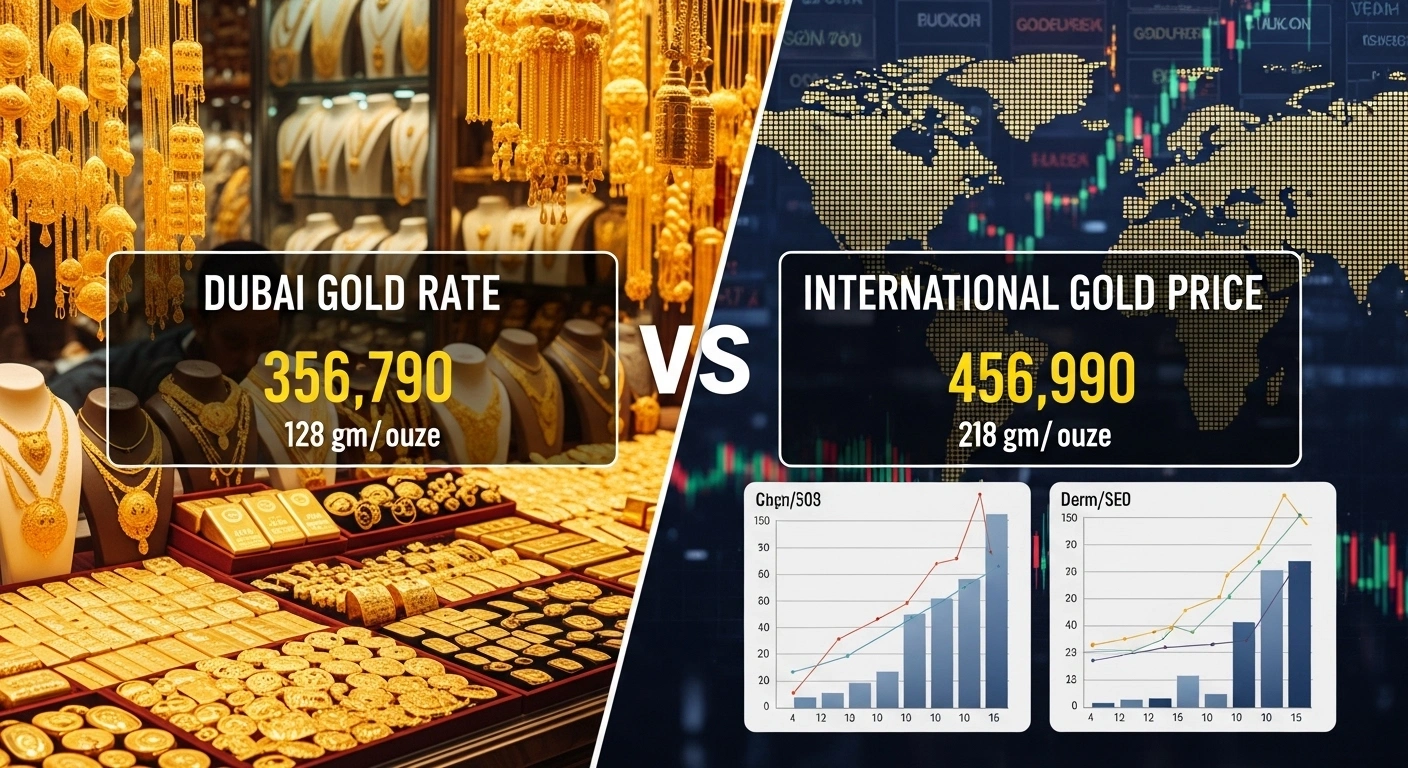
Dubai gold rate vs international gold price is one of the most misunderstood comparisons in 2026. Many buyers see international gold at 2400 USD per ounce and then check the gold rate in UAE and notice a difference of 2 percent to 6 percent per gram. The confusion comes from mixing wholesale spot price with retail consumer pricing. The solution is simple. Understand the formula, conversion process, and retail markup structure before comparing numbers.
In this guide, I will clearly break down how international spot price in USD per ounce converts into AED per gram, how VAT and retail premiums affect the Dubai board rate, and why jewellery prices differ further. I will include step by step formula explanations, real world examples, and comparison tables using 2022 to 2026 data. If you want historical volatility context, you can review the gold price history chart to see how global spot trends translate into local pricing.
By the end, you will understand whether Dubai is truly cheaper, when price gaps widen, and which rate investors or jewellery buyers should actually track in 2026.
Quick Answer – Why Is Dubai Gold Rate Different from International Gold Price?
Dubai gold rate vs international gold price differs because the international price is a wholesale spot benchmark quoted in USD per ounce, while the Dubai rate is that spot price converted into AED per gram plus a small retail premium. On top of that, 5 percent VAT and jewellery making charges increase the final consumer price, which creates the visible gap buyers notice.
What Is the International Gold Price
To understand Dubai gold rate vs international gold price, I first clarify what the international price actually represents. The international gold price is the global wholesale benchmark used by banks, central institutions, and commodity traders. It reflects the real time market value of pure gold before any local taxes, retail margins, or jewellery fabrication costs are added.
This price acts as the foundation for all local gold markets including the UAE. Whether you check the gold rate in UAE or compare regional pricing such as gold price in Saudi Arabia, everything ultimately starts from the international spot benchmark.
Gold Spot Price Definition
The gold spot price is quoted as XAU USD per troy ounce. XAU represents one troy ounce of gold, which equals 31.1035 grams. This price is traded actively on global exchanges such as COMEX in the United States and is influenced by pricing benchmarks from the London Bullion Market Association.
The spot price updates every few seconds during active trading hours. It moves based on supply and demand, inflation expectations, central bank policies, geopolitical risk, and currency strength. When you see gold at 2400 USD per ounce, that is the wholesale global value before conversion into any local currency.
For historical context and volatility trends, I always review the gold price history chart to understand how international price cycles behave over time.
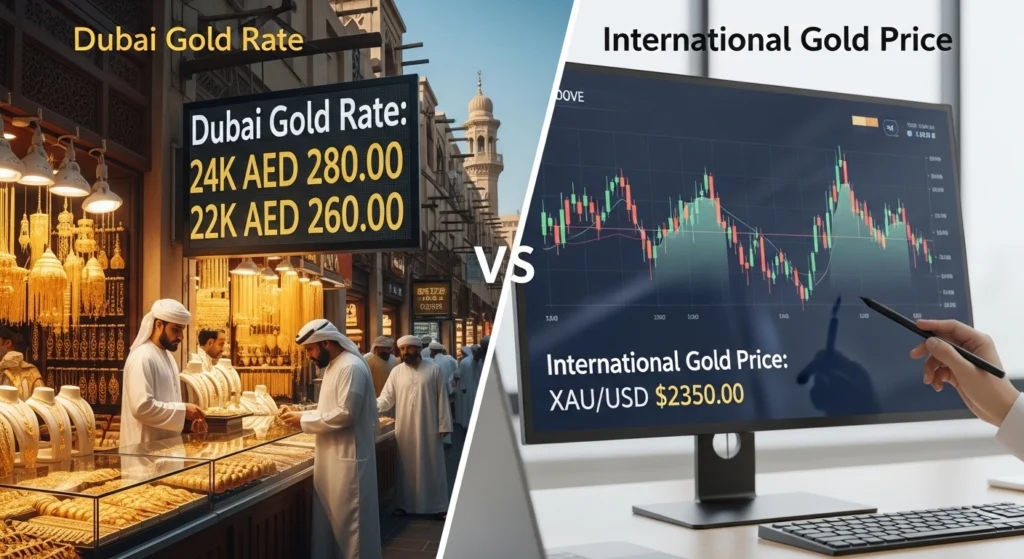
Table 1 – Spot Price Components
| Factor | Explanation | Impact on Price |
|---|---|---|
| Global Demand | Jewellery, investment, central bank buying | Higher demand pushes price upward |
| USD Strength | Gold is priced in USD | Strong USD often pressures gold downward |
| Interest Rates | Central bank policy rates | Higher rates can reduce gold appeal |
| Geopolitical Risk | Wars, instability, uncertainty | Risk increases safe haven demand |
| Inflation Expectations | Rising consumer prices | Higher inflation supports gold demand |
The international gold price is therefore a macroeconomic benchmark, not a retail consumer price. It is the starting point from which local markets like Dubai derive their daily rates.
What Is Dubai Gold Rate
Dubai gold rate is the local retail price quoted in AED per gram, derived directly from the international gold spot benchmark. However, unlike the wholesale XAU USD price, the Dubai rate reflects currency conversion, small retail premiums, and the structured UAE gold market framework. When buyers check the gold rate in UAE, they are seeing a converted and localized version of the global benchmark.
The key difference is that Dubai pricing operates in grams, not ounces. It also reflects real time USD to AED conversion because the UAE dirham is pegged to the US dollar. Understanding this conversion step explains most of the visible gap between Dubai gold rate vs international gold price.
How Dubai Converts International Price to AED per Gram
The conversion process follows a structured formula. First, the international spot price quoted per troy ounce must be converted into price per gram. One troy ounce equals 31.1035 grams.Spotpergram=Spotperounce÷31.1035
Next, that per gram USD value is converted into AED using the USD to AED rate, which remains relatively stable due to the currency peg.AEDpergram=Spotpergram×USD/AEDrate
After this base conversion, retailers may add a small premium to cover logistics, hedging, and operational cost. Jewellery prices then include making charges and 5 percent VAT.

Table 2 – Spot vs Dubai Base Rate Conversion Example
Assume international gold is 2400 USD per ounce and USD to AED rate is 3.67.
| Spot USD per oz | USD to AED | AED per gram Base | Retail Board Rate | Difference |
|---|---|---|---|---|
| 2400 | 3.67 | Approximately 283 AED | 284 to 286 AED | 1 to 3 AED retail premium |
This example shows that the difference between theoretical converted value and Dubai board rate is usually small at the base bullion level. Larger gaps appear when comparing jewellery prices because making charges and VAT apply.
For historical volatility comparison, I always review the gold price history chart to see how international movements translate into local board adjustments over time.
Formula Breakdown – From International Spot to Dubai Retail
To properly understand Dubai gold rate vs international gold price, I always break the pricing into three mathematical layers. First comes the global wholesale spot price. Second comes currency conversion into AED per gram. Third comes the retail markup layer that includes premium, VAT, and in case of jewellery, making charges.
The entire difference becomes logical once you apply the formula step by step instead of comparing headline numbers.
Step 1 Convert Spot Price Per Ounce to Per Gram
International gold is quoted per troy ounce, but Dubai gold rate is quoted per gram. Since one troy ounce equals 31.1035 grams, we convert it as follows.Spotpergram=Spotperounce÷31.1035
If gold is 2400 USD per ounce, dividing by 31.1035 gives the USD value per gram.
24k gold price in dubai per gram today in usd
Many people searching for 24k gold price in dubai per gram today in usd are trying to solve a simple but important problem. They want to know the exact gold…1 gram gold price in Dubai in Indian rupees today live
Many people searching for 1 gram gold price in dubai in indian rupees today live are trying to solve a very practical problem. They want to know the exact price…


Step 2 Convert USD Per Gram to AED
Dubai pricing uses AED, and since the UAE dirham is pegged to the US dollar at approximately 3.67, we multiply the USD per gram by the exchange rate.AEDpergram=Spotpergram×USD/AED
This gives the theoretical base bullion rate in AED per gram. You can compare this number with the live gold rate in UAE to see how closely the board rate follows global pricing.
Step 3 Add Retail Premium and Tax Layer
After conversion, retailers add a small operational premium. This covers logistics, hedging cost, and showroom operations. For bullion, this premium is often 0.5 percent to 2 percent.
For jewellery, two additional layers apply. First is the making charge, which can range from 7 percent to 15 percent depending on design complexity. Second is 5 percent VAT applied on the final value.
So conceptually, the retail jewellery formula becomes:
Retail Jewellery Price equals Base AED per gram plus Retail Premium plus Making Charge plus VAT.

This layered structure explains why Dubai gold rate vs international gold price can look similar at the bullion level but significantly different at the jewellery level. Understanding each layer prevents misinterpretation and helps buyers calculate accurately rather than relying on assumptions.
Key Factors That Create the Price Gap
When comparing Dubai gold rate vs international gold price, the visible gap does not come from one single source. It is the result of layered economic and retail factors. Once I break these components down individually, the difference becomes logical rather than confusing.
The international spot price is a wholesale benchmark. Dubai pricing reflects real world conversion, local tax rules, and retail structure. Below are the main drivers that create the price gap.
Currency Conversion Effect
The international gold price is quoted in USD, while Dubai gold rate is quoted in AED per gram. The UAE dirham is pegged to the US dollar at approximately 3.67, which creates currency stability. This peg reduces volatility compared to countries with floating currencies.
Because of this fixed relationship, Dubai pricing closely tracks international movement. However, small timing differences and conversion rounding can create minor gaps between theoretical and retail rates. Buyers comparing rates across countries should also monitor the AED to INR gold rate if converting for cross border purchases.
Import and Logistics Costs
Gold entering the UAE must pass through refining, transportation, insurance, and compliance processes. Although the UAE is one of the world’s largest gold trading hubs, operational costs still exist. These costs are minimal compared to many countries, which is why Dubai often appears competitive globally.
The UAE’s advanced supply chain infrastructure helps keep these costs low. This is one reason why Dubai pricing often remains close to the converted spot value.
Retail Premium and Profit Margin
Retailers apply a small premium above the converted base bullion rate. This covers hedging against short term volatility, showroom expenses, staff, and operational overhead. For bullion, this premium is usually between 0.5 percent and 2 percent.
You can compare this premium visually by checking the live gold rate in Dubai against the calculated theoretical rate from the previous formula section.
VAT Impact in UAE
The UAE applies 5 percent VAT on gold jewellery. Investment grade gold may qualify for different tax treatment depending on purity and transaction type. This tax layer increases the final consumer price compared to the international wholesale benchmark.
It is important to understand that VAT is applied at the retail level, not included in the global spot price.
Making Charges for Jewellery
Making charges are the largest contributor to the gap when comparing jewellery prices. These fabrication costs can range from 7 percent to 15 percent depending on design complexity and brand positioning.
For example, while bullion may closely mirror spot conversion, jewellery pricing diverges significantly due to craftsmanship cost. Buyers who want to understand seasonal fluctuation in these charges can review wedding season gold demand UAE trends 2026 for deeper insight.
Together, these five factors explain why Dubai gold rate vs international gold price will never be identical, even though they are fundamentally linked through global market mechanics.
Historical Comparison – Dubai vs International 2022 to 2026
To properly understand Dubai gold rate vs international gold price, I always look at multi year averages rather than one day comparisons. Over the past five years, global spot prices have risen significantly, especially during inflationary and geopolitical cycles. Dubai pricing has closely tracked those movements because of the USD peg and direct conversion structure.
However, a consistent 1 percent to 3 percent structural difference appears due to retail premium and rounding adjustments. When comparing five year averages, the relationship remains stable rather than random.
If you review long term volatility patterns in the gold price history chart, you will notice that Dubai board rates mirror international trend direction almost immediately, with only marginal spread variation.
Table 3 – 5 Year Comparison
Below is an averaged comparison based on yearly trends from 2022 through 2026. Values represent rounded yearly averages to show structural relationship rather than daily fluctuations.
| Year | Avg Spot USD per oz | Avg Dubai 24K AED per g | % Difference | Notes |
|---|---|---|---|---|
| 2022 | 1800 to 1850 | 212 to 218 | 1% to 2% | Strong post pandemic demand and inflation support |
| 2023 | 1900 to 1950 | 224 to 231 | 1% to 2% | Rising interest rate volatility |
| 2024 | 2100 to 2200 | 247 to 259 | 1% to 2.5% | Geopolitical uncertainty supported gold |
| 2025 | 2250 to 2350 | 265 to 277 | 1% to 3% | Continued inflation hedge demand |
| 2026 | 2350 to 2450 | 276 to 288 | 1% to 3% | Stable USD peg keeps conversion tight |
Statistical Insight
Across 2022 to 2026, the average structural spread between converted theoretical spot and Dubai board rate remained relatively narrow. The variation typically stayed below 3 percent for bullion grade 24K gold.
The main takeaway is that Dubai does not create an independent pricing trend. It reflects international movement with minimal structural premium. Larger visible gaps appear only when comparing jewellery retail prices, not bullion board rates.
For investors and serious buyers, tracking international spot direction gives early indication of local movement. For practical purchasing decisions, monitoring the live gold rate in UAE ensures you see the real time converted retail rate.
This five year comparison confirms that Dubai gold rate vs international gold price is structurally linked rather than disconnected.
Why Dubai Sometimes Appears Cheaper Than Other Countries
When comparing Dubai gold rate vs international gold price with other countries, Dubai often appears more affordable. This perception is not accidental. It is driven by structural advantages in taxation, currency stability, supply chain efficiency, and intense retail competition.
I have observed that buyers comparing Dubai with markets like India or certain GCC neighbors frequently notice narrower spreads between converted spot and retail rates. The reasons below explain why that happens.
Low Tax Structure
The UAE applies 5 percent VAT on jewellery, which is lower than indirect tax burdens in several other countries. Some countries impose higher import duties, customs charges, or additional sales taxes that increase final consumer pricing. Because of this relatively moderate tax structure, Dubai’s effective gold pricing often remains closer to converted international spot.
Strong Supply Chain
Dubai is one of the world’s largest gold trading and refining hubs. Its logistics network connects directly with major refining centers and bullion markets. High trading volumes and efficient infrastructure reduce friction costs.
Lower operational inefficiencies mean smaller structural markups compared to markets where supply chains are fragmented. This contributes to competitive board rates visible on the gold rate in UAE.
USD Peg Stability
The UAE dirham is pegged to the US dollar at a fixed rate. Since international gold is priced in USD, this peg eliminates large currency fluctuations. In contrast, countries with floating currencies may experience additional volatility, which widens retail spreads.
Because of this stability, Dubai pricing closely mirrors global spot without currency distortion. This creates a perception of fairness and transparency in conversion.
Competitive Retail Market
Dubai’s gold market is highly competitive, with hundreds of retailers operating in close proximity. High competition limits excessive premium expansion. Retailers adjust margins quickly to stay aligned with market expectations.
Promotional periods such as those discussed in Dubai Shopping Festival gold deals further intensify competition, temporarily reducing making charges and increasing discount activity.
For regional comparison, you can also review pricing differences in gold price in Qatar or gold price in Saudi Arabia to see how local policy and tax structures influence spreads differently.
Together, these structural factors explain why Dubai sometimes appears cheaper even though it still fundamentally follows international gold pricing mechanics.
When Dubai Gold Rate Moves Faster Than International Price
In theory, Dubai gold rate vs international gold price should move almost simultaneously because local pricing is derived directly from global spot. In practice, short term variations can appear. These differences are usually temporary and linked to retail mechanics rather than structural pricing gaps.
I have observed that during volatile market sessions, local retail boards may adjust slightly ahead of or behind global spot changes. This creates the impression that Dubai is moving faster or slower than the international benchmark.
Retail Reaction Lag
Global spot prices update every few seconds during active trading hours. Retail boards in Dubai update frequently, but not every second. When spot moves sharply within minutes, there may be a brief lag before all showrooms adjust.
This lag can work in both directions. If spot rises quickly, some retailers may update instantly while others follow shortly after. If spot falls, retail boards sometimes adjust with slight delay to manage volatility exposure.
Inventory Pricing
Retailers often hold physical inventory purchased at earlier price levels. When spot moves sharply upward, existing inventory purchased at lower prices can temporarily protect margins. When spot falls sharply, retailers may slow price reductions to avoid losses on higher cost inventory.
This inventory management behavior can create short term differences between theoretical converted value and displayed board rate on the gold rate in UAE.
Weekend Price Stability
International gold markets may close on weekends depending on exchange schedules. During these periods, Dubai retail pricing may appear stable because global reference trading is limited.
In addition, showrooms sometimes prefer stable pricing during high weekend footfall periods to reduce confusion among buyers. This creates temporary pricing smoothness even when futures markets are reacting to new information.
Over longer periods, however, Dubai gold rate vs international gold price remains structurally aligned. Short term divergence is usually operational rather than fundamental.
Jewellery vs Investment Gold – Price Difference Explained
When comparing Dubai gold rate vs international gold price, many buyers forget to separate bullion from jewellery. Investment gold such as coins and bars stays very close to converted spot value. Jewellery pricing moves further away because of craftsmanship, branding, and retail margins.
If you check the live gold rate in UAE, you are usually seeing the base bullion board rate for 24K gold. The moment that gold is turned into a necklace or bridal set, additional cost layers are added.
Coins and Bars vs Jewellery
Coins and bars are designed for investment purposes. Their pricing structure is simple and highly transparent. Jewellery, on the other hand, includes fabrication complexity and aesthetic value, which increases premium.
| Type | Linked to Spot? | Premium % | Price Sensitivity |
|---|---|---|---|
| 24K Gold Bars | Very closely linked | 0.5% to 2% | Highly sensitive to spot movement |
| 24K Gold Coins | Closely linked | 1% to 3% | Highly sensitive |
| Simple 22K Jewellery | Moderately linked | 7% to 12% | Moderately sensitive |
| Designer Bridal Jewellery | Loosely linked | 10% to 20% or more | Less sensitive due to making cost |
For investment buyers, coins and bars move almost in parallel with international spot price. When spot rises or falls, bullion pricing reflects it immediately.
Jewellery behaves differently. Even if international spot drops slightly, high making charges may prevent the final price from falling proportionally. This is why investors track spot and board rate, while wedding buyers must calculate total invoice value.
Understanding this distinction helps avoid confusion when comparing Dubai gold rate vs international gold price across different product categories.
Exchange Rate Sensitivity Analysis
When analyzing Dubai gold rate vs international gold price, exchange rate sensitivity plays a critical role. Even though the UAE dirham is pegged to the US dollar, small shifts in the dollar’s global strength influence international gold valuation itself. Gold is priced in USD, so any major USD movement directly affects spot price before it is converted into AED.
Because of the peg at approximately 3.67, AED to USD volatility is extremely limited. This stability reduces currency distortion compared to countries with floating exchange rates. However, global USD strength still influences gold direction, which indirectly affects Dubai retail pricing.
To understand the base conversion link clearly, the core relationship is:AEDpergram=(SpotUSDperoz÷31.1035)×3.67
This formula shows why AED pricing mirrors USD spot movement almost mechanically.
Table 4 – AED USD Stability Impact
| USD Move | Spot Impact | Dubai Retail Impact |
|---|---|---|
| USD Strengthens Globally | Gold often weakens in USD terms | Dubai price falls in line with spot |
| USD Weakens Globally | Gold often strengthens in USD terms | Dubai price rises with spot |
| USD Stable | Spot driven by inflation or demand factors | Dubai mirrors spot closely |
| Major USD Volatility | Short term spot swings increase | Retail boards adjust frequently |
When the dollar strengthens against other global currencies, gold typically faces downward pressure because it becomes more expensive in non USD markets. When the dollar weakens, gold often rises as an inflation hedge.
In the UAE context, the AED peg prevents local currency volatility from widening spreads. This is why Dubai gold rate vs international gold price remains structurally aligned over time. Larger visible differences usually come from retail premium and making charges rather than currency instability.
Real Example – If International Gold Is 2400 USD per Ounce
When I compare Dubai gold rate vs international gold price, I like using one clear example so the math feels practical. The problem most buyers face is that 2400 USD per ounce looks like a single number, but Dubai prices are shown in AED per gram. The solution is to convert step by step and then compare your theoretical result with the live retail board on the gold rate in UAE.
In 2026, this approach helps me avoid guessing whether Dubai is overpricing or simply reflecting taxes and retail premiums. Once the conversion is done correctly, the remaining difference is usually a small retail premium for bullion and a larger gap for jewellery because of making charges and VAT.
Step by Step Calculation
Structured Comparison Table
Assumptions used in this example are a USD to AED rate of 3.67 and a small bullion retail premium range.
| Item | Value | Result |
|---|---|---|
| International Spot Price | 2400 USD per ounce | Global benchmark |
| Spot per Gram in USD | 2400 divided by 31.1035 | About 77.16 USD per gram |
| Theoretical AED per Gram | 77.16 multiplied by 3.67 | About 283.2 AED per gram |
| Typical Dubai Retail Board Range | Board rate varies by retailer | About 284 to 286 AED per gram |
| Difference Explained | Retail premium and rounding | About 0.3% to 1% |
If the live Dubai 24K board rate is within a couple of dirhams of the theoretical number, that is normal. The larger gaps usually start when you move from bullion pricing to jewellery pricing because making charges and 5 percent VAT get added.
If you want to calculate this for your own spot price, purity, and weight, I use the gold price calculator Dubai to quickly convert and compare scenarios without manual effort.
Which Price Should Investors Track
When analyzing Dubai gold rate vs international gold price, the right benchmark depends on who you are and what your goal is. Many investors make the mistake of tracking only one number without understanding how it applies to their situation. I always align the price reference with the purpose of the purchase.
If you are a short term trader or global investor, the international spot price is your primary signal. If you are a UAE resident buying bullion or jewellery, the local board rate matters more. If you are an NRI buyer planning cross border transfer, currency movement becomes equally important.
Traders Follow Spot
Professional traders and institutional investors track the international XAU USD spot price. This is the global benchmark traded on major exchanges and reacts instantly to macroeconomic events. Futures contracts, hedging strategies, and ETF positions are based on spot movement rather than retail rates.
Spot reflects inflation data, interest rate decisions, geopolitical risk, and dollar strength. It is the earliest indicator of global direction.
UAE Residents Follow Local Board Rate
If you live in the UAE and plan to buy gold physically, the most practical reference is the gold rate in UAE. This rate already includes currency conversion and local retail structure. For bullion buyers, this number closely mirrors spot after conversion.
For jewellery buyers, I also recommend using the gold price calculator Dubai to estimate total invoice including making charges and VAT. This prevents confusion between wholesale benchmark and consumer pricing.
NRI Buyers Monitor Currency
For NRI buyers who intend to carry gold abroad or convert value into another currency, exchange rate is critical. Even if spot price remains stable, currency movement can change final savings significantly. Monitoring the AED to INR gold rate helps determine optimal buying windows.
In summary, investors should track the price that aligns with their objective. Spot guides global trend direction. Dubai board rate guides local purchase decisions. Currency tracking protects cross border value.
FAQs
Is Dubai gold price same as international gold price?
No, Dubai gold price is not exactly the same as the international gold price. The international price is a wholesale spot rate quoted in USD per ounce, while Dubai rate is converted into AED per gram and includes a small retail premium. Jewellery prices also add VAT and making charges.
Why is Dubai gold cheaper than some countries?
Dubai often appears cheaper because of its 5 percent VAT, strong supply chain, and high retail competition. Many countries impose higher import duties or taxes, which increase consumer prices. Since the UAE dirham is pegged to the US dollar, currency volatility also remains minimal compared to floating currency markets.
Does VAT affect Dubai gold rate?
Yes, VAT affects the final consumer price. The base bullion board rate closely follows converted international spot price, but 5 percent VAT is applied at the retail level for jewellery purchases. Investment grade gold may have different treatment depending on transaction type and purity.
How often does Dubai gold rate change?
Dubai gold rate changes frequently during active international trading hours. Since pricing is derived from global spot markets, updates can occur multiple times per day. Retail boards adjust based on real time international movement and local market conditions.
Is 24K price in Dubai linked directly to spot price?
Yes, 24K gold price in Dubai is directly linked to the international spot benchmark after conversion into AED. The difference is usually a small retail premium. Larger gaps occur mainly in jewellery pricing due to fabrication and VAT layers rather than bullion pricing.
Final Verdict – Understanding the Real Price Difference
After comparing Dubai gold rate vs international gold price from formula level to retail invoice level, the conclusion becomes clear. The difference is not manipulation or hidden markup. It is simply layered pricing moving from global wholesale benchmark to local consumer product.
Here is the structured takeaway.
• Spot equals global benchmark
The international spot price quoted in USD per ounce is the foundation. It reflects global supply, demand, inflation expectations, and currency strength. This is the number institutional traders and global investors follow.
• Dubai equals converted plus retail premium
Dubai gold rate is the spot price converted into AED per gram using the USD peg, plus a small operational premium. For bullion, the difference from theoretical conversion usually stays within 1 percent to 3 percent. You can verify this anytime on the gold rate in UAE.
• Jewellery equals final consumer price
Jewellery pricing includes making charges, branding cost, and 5 percent VAT. This is where the visible gap becomes larger. The final invoice reflects craftsmanship and retail structure, not just metal value.
In practical terms, investors should track spot for direction, UAE buyers should track local board rate, and jewellery buyers must calculate total invoice value rather than relying on international headlines.
Data Sources and Methodology
Understanding Dubai gold rate vs international gold price requires transparent sourcing and consistent calculation standards. In this guide, I rely on globally recognized pricing benchmarks and verifiable local retail data rather than anecdotal comparisons. Every formula and example shown is derived from established market structure.
The international gold spot price reference comes from benchmarks set by the London Bullion Market Association and trading activity on COMEX futures markets. These institutions provide the wholesale XAU USD price per troy ounce that serves as the global base for all conversions.
Dubai pricing references are taken from publicly displayed UAE retail gold board rates such as the live gold rate in UAE. Historical movement comparisons are cross checked using the gold price history chart to confirm alignment between global spot and local board rates over time.
The USD to AED relationship is based on the official UAE dirham peg to the US dollar at approximately 3.67. This peg explains why local conversion remains structurally stable compared to countries with floating currencies.
Assumptions used in examples include a standard troy ounce conversion of 31.1035 grams, average retail premium range between 1 percent and 3 percent for bullion, and making charge ranges between 7 percent and 15 percent for jewellery. VAT calculations assume the standard 5 percent UAE rate applied at retail level.
All tables are designed to show structural relationships rather than daily fluctuations. The objective is clarity, transparency, and practical accuracy so readers can verify numbers independently and understand how pricing layers interact in real market conditions.