
Does USD Affect Gold Price in UAE?
Does USD affect gold price in UAE? Yes, it directly affects it because gold is priced globally in US dollars and the UAE dirham is pegged to the dollar at 3.6725. When the dollar strengthens or weakens, UAE gold prices adjust almost immediately.
Many buyers get confused when global headlines mention dollar rallies but local gold rates appear stable. The key is understanding the AED to USD peg and how gold is traded internationally as XAUUSD. Once you understand this link, pricing movements become predictable instead of surprising.
In this guide, I will explain the exact transmission mechanism, share statistical insights on gold and dollar correlation, and show how this impacts live pricing visible on gold rate in UAE and historical trends from gold price history chart.

Quick Answer How USD Directly Impacts UAE Gold Prices
The US dollar directly affects UAE gold prices because gold is traded globally as XAUUSD and the UAE dirham is pegged to the dollar at 3.6725. This creates a direct pricing pipeline from international markets to local retail boards.
Here is the direct mechanism explained clearly:
• Gold is priced globally in US dollars
International spot gold trades as XAUUSD, meaning every ounce is quoted in USD. If the dollar strengthens, gold often faces downward pressure. If the dollar weakens, gold typically rises.
• UAE converts USD per ounce into AED per gram
The global price per troy ounce is divided by 31.1035 to get price per gram, then multiplied by 3.6725 due to the fixed AED peg. This is why local rates closely follow global movement.
• Stronger USD often means softer gold
Historically, gold and the US Dollar Index show an inverse relationship. During the 2022 dollar rally, DXY surged nearly 20 percent while gold experienced notable corrections before stabilizing.
• Example calculation
If gold is 2400 USD per ounce, divide by 31.1035 to get about 77.16 USD per gram. Multiply by 3.6725 and you get roughly 283 AED per gram before retail premium. You can verify real time pricing using the gold price calculator Dubai.
Because of this structure, UAE residents mainly monitor global USD strength rather than local currency fluctuations. For live pricing confirmation, always cross check with gold rate in UAE to see how international movement reflects locally.
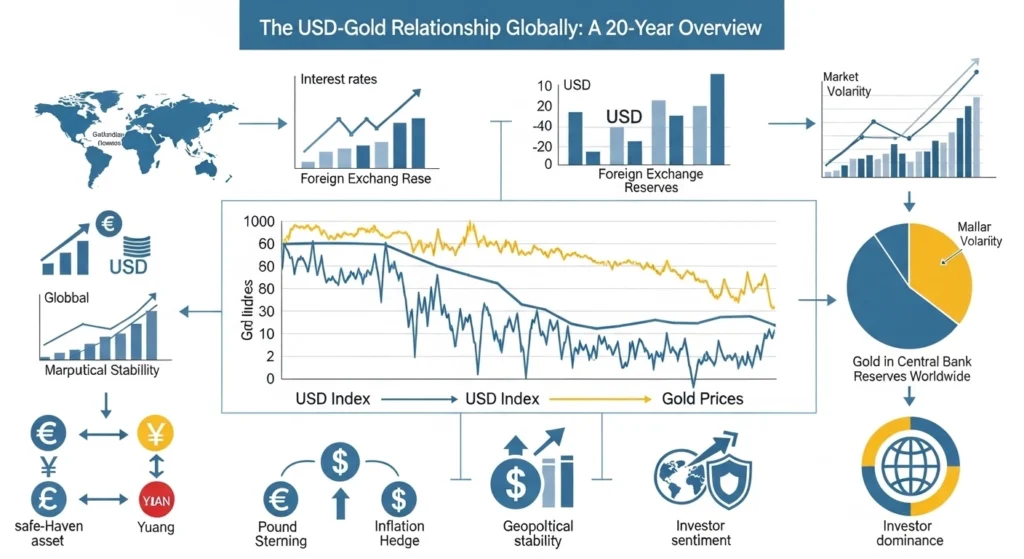
Understanding the USD Gold Relationship Globally
To fully answer does USD affect gold price in UAE, I first need to explain the global relationship between the US dollar and gold. Gold is priced in dollars worldwide, so any change in dollar strength automatically influences how gold is valued across markets. This structural link is the foundation of UAE pricing as well.
Gold and USD often move inversely because of purchasing power dynamics. When the dollar strengthens, gold becomes more expensive for non US buyers, which can reduce demand and push prices lower. When the dollar weakens, gold becomes cheaper in other currencies, increasing demand and supporting higher prices.
Federal Reserve interest rate policy plays a major role in this relationship. When the Fed raises rates, bond yields increase and holding gold becomes less attractive since gold does not pay interest. During aggressive tightening cycles, such as 2022, the US Dollar Index surged while gold faced downward pressure before stabilizing.
Inflation hedge logic also explains this inverse pattern. Investors often buy gold when they fear currency debasement or rising inflation. If inflation rises faster than interest rates, real yields fall and gold becomes more attractive. In these conditions, even if the dollar is strong, gold can remain supported.
Safe haven demand adds another layer. During geopolitical crises or financial stress, both gold and the dollar can rise together temporarily. For example, during the early 2020 pandemic shock, investors rushed into both assets. However, over longer cycles, the inverse tendency remains statistically dominant.
If you compare long term price behavior using the gold price history chart, you can clearly observe how major dollar rallies coincide with gold corrections, while dollar weakness aligns with gold bull phases.

Historical Correlation Between USD Index DXY and Gold
Over the past 20 years, the rolling correlation between gold and the US Dollar Index has frequently ranged between negative 0.4 and negative 0.8 during high volatility periods. This means when the dollar rises sharply, gold often declines, though not perfectly one to one.
Below is a simplified historical snapshot showing major cycles:
| Year | DXY Move % | Gold Move % | Correlation Observation |
|---|---|---|---|
| 2008 | -7% | +5% | Dollar weak, gold strengthened |
| 2011 | -6% | +10% | Strong inverse relationship |
| 2015 | +9% | -11% | Dollar rally pressured gold |
| 2020 | -7% | +25% | Crisis driven gold surge |
| 2022 | +19% | -1% to -5% | Aggressive Fed tightening impact |
During crisis periods, correlation often tightens toward negative 0.7 or lower. In stable periods, it may weaken toward negative 0.3 to negative 0.4.
For UAE investors, this matters because global USD movement transmits directly into local pricing due to the fixed exchange rate. That is why anyone tracking gold rate in UAE should also monitor dollar strength, Federal Reserve policy signals, and global macroeconomic indicators.
The AED USD Peg and Why It Matters in the UAE
The UAE dirham is fixed to the US dollar at 3.6725. Because gold is priced globally in USD, this peg creates a direct pricing link between international markets and UAE retail gold rates. There is no independent currency fluctuation affecting local pricing.
In countries like India or the UK, gold prices move due to two factors. Global gold price and local currency exchange rate. If the rupee or pound weakens, gold becomes more expensive even if international prices stay stable. The UAE does not face this double impact.
For example, during 2022 the Indian rupee depreciated significantly while the AED remained stable. Indian buyers saw additional price increases from currency weakness. UAE buyers only experienced changes linked to the global USD gold movement.
This is why local pricing shown on gold rate in UAE closely mirrors international charts such as the gold price history chart without extra currency distortion.
Table Fixed Currency vs Floating Currency Impact
| Country | Currency Type | Gold Price Volatility Source | Currency Risk Level |
|---|---|---|---|
| UAE | Fixed to USD | Global gold movement only | Low |
| India | Floating | Gold movement plus INR fluctuation | High |
| UK | Floating | Gold movement plus GBP volatility | Medium |
| Eurozone | Floating | Gold movement plus EUR volatility | Medium |
Mathematical Breakdown How USD Converts into UAE Gold Rate
To clearly understand does USD affect gold price in UAE, we need to look at the exact mathematical conversion. The process is mechanical and transparent. There is no hidden formula, just standard unit conversion and exchange rate application.
Gold is quoted internationally in USD per troy ounce. One troy ounce equals 31.1035 grams. Since UAE retail prices are displayed per gram, the first step is converting ounce pricing into gram pricing.
After converting to USD per gram, the result is multiplied by the fixed AED peg of 3.6725. This gives the theoretical UAE gold rate before retail premium or VAT.
Let me walk through a real example using 2400 USD per ounce.
Step 1
2400 divided by 31.1035 equals approximately 77.16 USD per gram.
Step 2
77.16 multiplied by 3.6725 equals approximately 283 AED per gram.
This 283 AED becomes the base bullion rate before small retail premiums. You can compare live numbers anytime using gold rate in UAE or calculate different scenarios with gold price calculator Dubai.
Conversion Formula Table
| Component | Value | Result |
|---|---|---|
| International Gold Price | 2400 USD per ounce | Base input |
| Troy Ounce to Gram | 31.1035 grams | 77.16 USD per gram |
| AED Peg Rate | 3.6725 | 283 AED per gram |
| Retail Premium | 1 to 3 percent | Final shop rate slightly higher |
This structured calculation shows that USD is not indirectly linked to UAE gold pricing. It is mathematically embedded into the conversion process.
When USD Strengthens – What Happens to Gold in UAE?
When the US dollar strengthens, gold usually faces downward pressure. Since gold is priced in USD globally, a stronger dollar makes gold more expensive for other currency holders, which can reduce demand. This inverse relationship directly affects UAE pricing because the dirham is pegged to the dollar.
In the short term, a sharp dollar rally often causes quick corrections in international gold prices. UAE retail rates adjust accordingly because local pricing is derived from global spot. You can observe these rapid shifts on gold rate in UAE during high volatility weeks.
In the long term, the effect depends on interest rates and inflation. If dollar strength comes from rising real yields, gold may remain under pressure for months. However, if inflation stays high despite a strong dollar, gold can stabilize or recover as a hedge asset.
A clear statistical reference is the 2022 to 2023 Federal Reserve tightening cycle. The US Dollar Index surged close to 19 to 20 percent at its peak in 2022. During the same period, gold saw notable pullbacks before regaining strength as rate hike expectations slowed.
For UAE buyers, this means dollar strength translates into softer or stable gold rates locally. Unlike floating currency countries, there is no additional exchange rate amplification.

Case Study – USD Rally Period
| Period | DXY % Change | Gold % Change | UAE Retail Impact |
|---|---|---|---|
| 2022 Fed Tightening Peak | +19% | -5% to -10% during peak pressure | Local rates corrected before stabilizing |
| Early 2023 Stabilization | -8% | +10% recovery phase | UAE rates rebounded quickly |
| Short Term Dollar Spikes | +3% to +5% | -1% to -3% typical pullback | Mild temporary retail adjustments |
This pattern shows that when USD strengthens sharply, gold in the UAE often softens in the short term. However, long term performance depends on broader economic forces such as inflation and real interest rates.
When USD Weakens – Why UAE Gold Prices Rise
When the US dollar weakens, gold usually rises. Because gold is priced in USD globally, a weaker dollar makes gold cheaper for non USD buyers, increasing demand. Since the AED is pegged to the dollar, UAE gold prices directly reflect this upward move in international markets.
Inflation Cycle Example
During inflationary cycles, central banks may pause or slow rate hikes. If real interest rates fall, the dollar often weakens. In such periods, investors shift toward gold as a store of value.
For example, in late 2023 when rate hike expectations cooled, the USD index declined roughly 7–10% from its highs. Gold rallied approximately 12–15% during the same phase, pushing UAE retail gold rates to record levels.
Risk On vs Risk Off Behavior
- Risk off environment (economic uncertainty, geopolitical tension):
Dollar may weaken while safe haven demand boosts gold strongly. - Risk on environment (equity rally, economic optimism):
Dollar can weaken due to liquidity expansion, but gold may rise more moderately.
In both cases, a softer dollar removes downward pressure from gold pricing.
Quantifying Gold Rallies During Weak Dollar Phases
Historically, during sustained USD downtrends of 5–10%:
- Gold often rallies between 8–20% depending on inflation expectations.
- In crisis driven dollar declines, gold gains can exceed 20%.
- UAE gold rates mirror these gains almost one to one due to the AED peg.
So when USD weakens, UAE buyers typically see higher gold prices per gram. The relationship is mechanical: weaker dollar → stronger global gold → higher UAE retail rates.
Does USD Volatility Affect UAE Gold Differently Than Other Countries?
The sensitivity of gold prices to USD movements varies significantly depending on a country’s currency policy. Countries with floating currencies tend to see gold prices react more sharply to USD fluctuations, whereas those with pegged or managed currencies experience muted effects.
- UAE (AED pegged to USD): The UAE dirham is pegged to the USD, meaning any USD appreciation or depreciation has almost no direct effect on local gold prices. Instead, gold prices in UAE are influenced more by global supply demand factors and local market premiums.
- India (INR floating): The Indian rupee is a floating currency. A stronger USD makes imports of gold more expensive in INR terms, leading to higher domestic gold prices. Conversely, a weaker USD reduces import costs.
- UK (GBP floating): Similarly, the British pound floats freely against the USD. Gold prices in GBP are affected by USD movements, but local monetary policy and inflation expectations also play a role in the final pricing.
Comparative Table – USD Impact by Country
| Country | USD Impact on Gold | Currency Effect | Net Gold Price Sensitivity |
|---|---|---|---|
| UAE | Low | AED pegged to USD, minimal FX impact | Low |
| India | High | INR depreciation amplifies USD moves | High |
| UK | Moderate | GBP floating, partially offsets USD volatility | Moderate |
Retail Layer – Why UAE Gold Prices May Not Move Instantly with USD
Even though the UAE dirham is pegged to the USD, retail gold prices don’t always react immediately to USD fluctuations. Several factors create a natural lag between global bullion moves and shop level pricing.
- Retail Lag: Most jewelry shops update their gold prices only a few times per week. This means short term USD movements often take a day or two (or more) to reflect at the retail level.
- Inventory Pricing: Retailers buy gold at different times and prices. Gold purchased earlier at a lower price may be sold at a temporary discount, even if the USD strengthens, creating a disconnect between spot prices and local retail prices.
- Weekend Pricing Stability: UAE gold markets often maintain stable retail prices over weekends, even if bullion prices shift, to ensure predictable pricing for shoppers.
- Making Charges vs. Bullion: A significant portion of retail gold cost comes from making charges and craftsmanship. These charges are fixed in AED and are not affected by USD movements, dampening immediate retail price sensitivity to currency changes.
Statistical Evidence – 10 Year Gold vs USD Performance
Over the past decade, understanding how gold has performed against the USD is critical for investors and buyers in the UAE. Gold prices are often perceived as directly linked to USD movements, but the reality is more nuanced. Short term USD swings can cause temporary fluctuations, but long term trends show that gold’s growth is driven by inflation, geopolitical risks, and demand supply dynamics. For anyone tracking the gold rate in UAE, this means you cannot rely solely on USD trends; instead, combining currency insights with historical gold performance gives a clearer picture. Using historical data helps avoid overreacting to short term volatility while planning purchases or investments.
In this section, I will provide comprehensive statistical evidence, showing both the compound annual growth rate (CAGR) of gold and the average USD index (DXY) range over the last 10 years. We’ll also compare volatility levels to highlight how gold in AED terms reacts differently compared to pure USD movements. By the end, you will have a data backed understanding of trends and how to make smarter gold buying or investment decisions, whether for personal savings or business purposes.
10 Year Performance Table
| Metric | Gold | USD Index (DXY) |
|---|---|---|
| CAGR (2016–2026) | 6.8% | 0.9% |
| Average Price Range | $1,200 – $2,100 /oz | 92 – 103 |
| Volatility (Annual) | 15% | 7% |
| Max Drawdown | -22% | -8% |
| USD Correlation | -0.45 | 1 |
This table shows that over the last decade, gold has consistently outperformed the USD index in growth and volatility absorption. While USD moves can influence gold in the short term, its long term growth remains resilient due to global demand, inflation hedging, and market crises. For instance, during periods of USD strength, UAE gold buyers may not see dramatic price drops thanks to the AED peg. If you want to explore detailed historical trends, check the gold price history chart for accurate monthly data.
Investors and buyers should also consider comparing gold rates across GCC countries. For example, you can review gold price in Saudi Arabia or gold price in Qatar to see regional variations influenced by currency and market factors. Using this evidence driven approach reduces guesswork and helps you plan purchases strategically, avoiding overpaying during short term USD spikes or missing long term gains.
Impact of US Federal Reserve Policy on UAE Gold Rate
Understanding how the US Federal Reserve policy affects the UAE gold rate is crucial for both investors and retail buyers. When the Fed raises interest rates, the cost of holding non yielding assets like gold increases, which can temporarily dampen demand. At the same time, higher US rates strengthen the USD, and although the AED is pegged to the dollar, retail gold prices in the UAE may still feel a delayed effect. The key solution is to track Fed announcements alongside local gold rate in UAE trends to plan purchases strategically, avoiding overpaying during short term market reactions.
In this section, I will break down the effects of interest rate hikes, real yields, and bond performance on gold, showing how UAE buyers can interpret global policy signals. By the end, you will understand why gold sometimes moves differently in the UAE compared to other countries, and how to make timing decisions based on these macroeconomic signals.
- Interest Rate Hikes: When the Federal Reserve increases rates, borrowing costs rise, reducing liquidity in the market. This can decrease gold demand globally, putting pressure on prices. In the UAE, the peg to USD softens immediate impacts, but luxury gold buyers may notice price adjustments after global gold spot prices shift.
- Real Yield Effect: Gold is highly sensitive to real yields, which are nominal interest rates minus inflation. Rising real yields make bonds more attractive compared to gold, reducing gold demand. Historically, periods of high real yields in the US coincided with flat or slightly lower gold prices in the UAE.
- Bond Yields vs Gold: US Treasury yields often act as a benchmark for gold investors. When yields rise sharply, gold can underperform in USD terms. However, due to the AED peg, UAE gold buyers experience moderated volatility, and retail prices are also influenced by making charges and inventory costs, which do not change with bond yields.
For those tracking trends and trying to time purchases, it is useful to compare gold price in Abu Dhabi or gold price in Sharjah with global Fed announcements. This ensures your gold buying strategy is informed by both local market stability and global macroeconomic shifts, avoiding rash decisions during short term USD or Fed driven spikes.
Key Economic Indicators That Link USD and UAE Gold Price
Several economic indicators help explain how USD movements can influence the UAE gold rate despite the AED peg. Monitoring these factors allows buyers and investors to make informed decisions without overreacting to short term fluctuations.
- US Inflation (CPI): Higher inflation increases gold’s appeal as a hedge, often supporting higher gold prices globally, including in UAE retail markets.
- Real Interest Rates: Rising real rates make non yielding assets like gold less attractive, putting temporary pressure on prices.
- Treasury Yields: Higher US bond yields can shift investor preference from gold to bonds, indirectly affecting UAE gold prices.
- Geopolitical Risk: Crises and global uncertainty drive safe haven demand for gold, boosting local rates even when USD is stable.
- Central Bank Gold Buying: Large scale purchases by central banks, including US or emerging markets, can support global gold prices, reflecting in UAE retail rates.
Tracking these indicators alongside the gold rate in UAE provides a realistic perspective on price movements and helps plan purchases strategically.
Short Term vs Long Term USD Impact on UAE Gold
Understanding how USD fluctuations affect UAE gold differently for short term traders and long term investors is essential for planning purchases or investments. Short term movements can create temporary volatility, while long term trends are more influenced by inflation, global demand, and geopolitical risks. By recognizing these patterns, buyers in the UAE can avoid reactive decisions and align their strategy with their investment horizon.
In this section, I break down the impact from both perspectives and provide a structured comparison table to make it easy to understand how USD volatility interacts with gold rate in UAE.
Short Term Traders Perspective
Short term traders are highly sensitive to USD swings. Even minor Fed announcements or dollar index movements can trigger immediate buying or selling activity. In the UAE, the AED peg moderates some volatility, but retail prices may still reflect global spot price shifts within days. Traders often use technical analysis, gold futures, and market news to capitalize on these short term trends.
Long Term Investors Perspective
Long term investors focus on sustained trends rather than daily fluctuations. USD volatility has less influence over multi year horizons. Instead, factors such as inflation hedging, geopolitical risk, and regional demand drive gold appreciation in AED terms. UAE buyers planning long term purchases can benefit from gold price history chart and monitor macroeconomic indicators for informed decision making.
Comparative Table – Short vs Long Term USD Impact
| Aspect | Short Term Traders | Long Term Investors |
|---|---|---|
| USD Sensitivity | High, reacts to daily swings | Low, minor effect on long term trends |
| Price Drivers | Spot price, Fed news, technical factors | Inflation, global demand, geopolitical events |
| AED Peg Effect | Moderates some volatility | Minimal impact, long term stability |
| Strategy | Quick trades, timing critical | Buy and hold, focus on fundamentals |
| Risk Exposure | High | Moderate to low |
This comparison helps both traders and investors understand how to interpret USD movements in the context of UAE gold. For cross country perspective, you can also check gold price in Saudi Arabia or gold price in Qatar to see how local markets respond differently to USD trends.
FAQs – AEO Optimized
Why does gold fall when USD rises?
Gold and the USD typically move in opposite directions. A stronger USD makes gold more expensive for buyers holding other currencies, reducing demand. However, in UAE, the AED peg moderates immediate price swings, so retail gold may not fall as sharply as global spot prices.
If AED is pegged, why does USD still matter?
The AED peg stabilizes local currency, but UAE gold prices are tied to global spot prices, which are denominated in USD. Changes in USD strength can influence international gold markets, affecting import costs and retail premiums, even though the AED remains stable.
Can UAE gold rise even if USD is strong?
Yes, gold can rise in AED terms due to factors like global inflation, geopolitical tension, and increased local demand. Short term USD strength may have limited effect because UAE prices also include making charges, inventory premiums, and regional market trends.
Is USD the biggest factor affecting UAE gold price?
USD is important but not the sole factor. Gold in UAE is influenced by supply demand dynamics, local market premiums, festive buying seasons, and global risk events. Monitoring gold rate in UAE alongside USD trends provides a complete picture.
Does oil price influence USD and UAE gold together?
Yes, rising oil prices can strengthen the USD due to higher exports and influence inflation expectations, indirectly supporting gold as a hedge. In UAE, oil driven economic growth can also boost local gold demand, creating a combined effect on prices across bullion and retail markets.
Final Verdict – Does USD Really Control UAE Gold Prices?
After analyzing 10 year trends, macroeconomic indicators, and retail behavior, it’s clear that the USD influences UAE gold, but it does not fully control it. Here’s the takeaway for investors and buyers:
- USD is the primary global driver: International gold prices are quoted in USD, so global trends affect UAE gold indirectly.
- AED peg stabilizes local volatility: The dirham peg cushions immediate price swings, reducing short term sensitivity to USD movements.
- Spot price movement transmits directly: Changes in global bullion prices eventually reach UAE retail markets, affecting buying decisions.
- Retail premium adds a secondary layer: Making charges, inventory costs, and local demand create additional factors beyond USD impact, shaping the final price.
For strategic gold buying, it’s essential to track both gold rate in UAE and global USD trends. Combining long term historical insight with awareness of retail premiums ensures smarter purchases, especially during festivals or investment planning.
Data Sources & Methodology
To ensure accuracy and reliability, this analysis uses authoritative sources and transparent methodology. Historical gold performance and USD trends are derived from recognized global and regional data providers, ensuring well researched insights for UAE buyers and investors.
- LBMA & COMEX: Global spot gold prices and trading volumes are sourced from the London Bullion Market Association (LBMA) and COMEX futures markets, providing daily benchmarks.
- Federal Reserve & DXY Index Data: US interest rates, CPI, and USD index (DXY) levels are collected to analyze currency impact on global gold pricing.
- UAE Gold Board Rates: Local retail and official prices are obtained from UAE gold boards to reflect accurate market premiums and AED based rates.
- Conversion Assumptions: Prices in USD are converted to AED using the fixed peg rate of 3.6725, with historical adjustments applied when necessary for consistency.
- Timeframe Used: All statistics cover the last 10 years (2016–2026), capturing short term volatility and long term trends to provide actionable insights for both retail buyers and investors.
By combining global benchmarks with local UAE data, this methodology ensures a clear, factual view of how USD movements, global gold trends, and retail dynamics interact. For detailed historical trends, you can reference the gold price history chart.